
Blog
Cagrilintide Research 2026: Amylin, CagriSema and Clinical Trial Evidence

Research notice: This guide is provided for scientific and educational purposes only. Cagrilintide remains an investigational compound. Clinical research results do not establish the suitability of independently supplied research materials for human or veterinary use. No personal dosing or administration advice is provided.
What Is Cagrilintide?
Cagrilintide research has become an important area of metabolic science, particularly as researchers explore alternatives and complementary approaches to glucagon-like peptide-1 (GLP-1) receptor agonists.
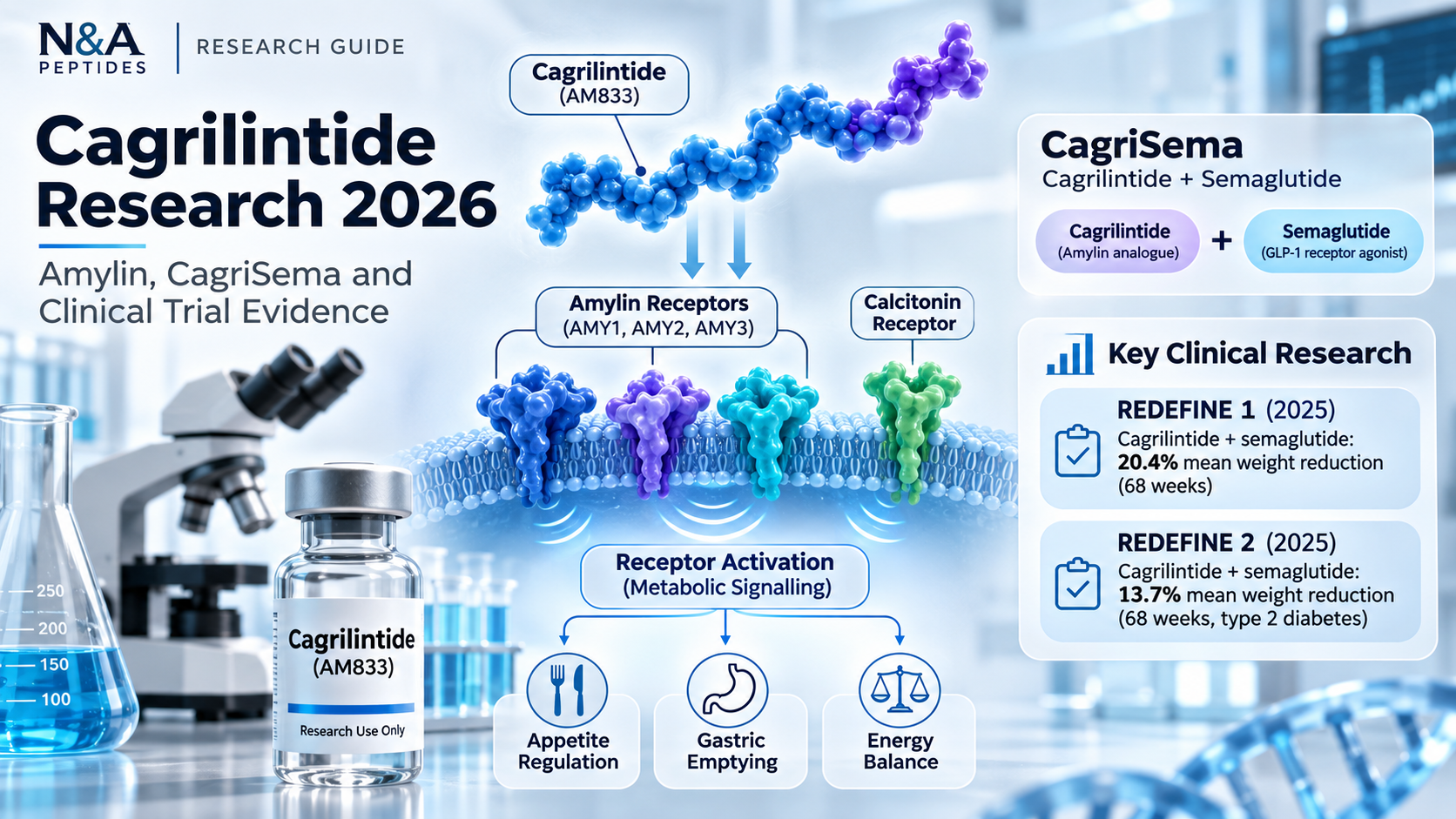
Cagrilintide, also known by the development identifier AM833, is a long-acting synthetic amylin analogue developed by Novo Nordisk. It has been investigated for its effects on appetite regulation, satiety signalling and body-weight outcomes in controlled clinical studies.
Unlike GLP-1 receptor agonists, cagrilintide primarily acts through the amylin and calcitonin receptor systems. These pathways have attracted considerable scientific interest because they participate in the regulation of food intake and energy balance.
Published research includes a Phase 2 monotherapy trial, the large Phase 3 REDEFINE programme and studies investigating cagrilintide alongside semaglutide in a combination known as CagriSema.
This N&A Peptides research guide examines the underlying biology, published clinical results, safety findings and developments available as of November 2026.
Understanding Amylin: The Hormone Behind Cagrilintide Research
Amylin is a naturally occurring peptide hormone produced by pancreatic beta cells and released alongside insulin in response to nutrient intake.
Its biological functions include contributing to meal-related satiety, gastrointestinal regulation and the coordination of metabolic responses after eating.
Three important areas of amylin research include:
- Satiety signalling: Amylin contributes to neural signalling associated with meal termination and sensations of fullness.
- Gastric emptying: Amylin can influence the movement of food from the stomach into the small intestine.
- Glucagon regulation: Amylin participates in physiological processes influencing post-meal glucagon secretion.
Researchers have investigated whether synthetic amylin analogues can reproduce selected aspects of these biological functions while providing different pharmacological properties from the naturally occurring hormone.
Natural amylin has limitations for pharmaceutical development, including aggregation behaviour and a relatively short duration of activity. Long-acting analogues such as cagrilintide have therefore become an important area of peptide engineering research.
How Does Cagrilintide Work?
Cagrilintide is an agonist of amylin receptors and the calcitonin receptor. An agonist is a compound that binds to and activates a biological receptor, initiating signalling processes within cells.
Amylin receptors are formed through interactions between the calcitonin receptor and proteins known as receptor activity-modifying proteins, or RAMPs.
Researchers distinguish three principal amylin receptor subtypes:
- AMY1 receptor
- AMY2 receptor
- AMY3 receptor
These receptor complexes can display different pharmacological characteristics depending on their molecular composition.
A 2025 structural investigation examined how cagrilintide interacts with the three amylin receptor subtypes and the calcitonin receptor.
Using cryo-electron microscopy and molecular analysis, investigators identified structural features involved in receptor binding and activation. These findings provided further insight into how engineered amylin analogues interact with their biological targets.
The research supports a more detailed understanding of cagrilintide’s molecular pharmacology. However, receptor binding and laboratory signalling results cannot independently establish clinical effectiveness or long-term safety.
Cagrilintide Compared With GLP-1 Receptor Agonists
One reason cagrilintide has attracted scientific attention is that its principal receptor targets differ from those of commonly studied incretin-based compounds.
GLP-1 receptor agonists act through the glucagon-like peptide-1 receptor, which participates in glucose-dependent insulin secretion and appetite-related signalling.
Cagrilintide instead investigates amylin and calcitonin receptor activation.
Although these signalling systems can influence some overlapping physiological outcomes, they should not be considered interchangeable.
Key Differences in Research Mechanisms
- Cagrilintide: A long-acting amylin analogue acting on amylin and calcitonin receptors.
- Semaglutide: A GLP-1 receptor agonist investigated and used in regulated clinical settings.
- Tirzepatide: A dual GIP and GLP-1 receptor agonist.
- Retatrutide: An investigational triple agonist targeting GIP, GLP-1 and glucagon receptors.
These differences are scientifically relevant because researchers can investigate how separate hormonal systems contribute to metabolic regulation.
For further information on multi-receptor research, read our Retatrutide Research 2026 guide.
Cagrilintide Phase 2 Clinical Research: The 2021 Trial
An important milestone occurred in 2021 when results from a randomised Phase 2 trial were published in The Lancet.
The multicentre study included 706 participants with overweight or obesity and evaluated cagrilintide monotherapy against placebo and an active comparator, liraglutide.
Participants were studied over a 26-week treatment period, with researchers investigating body-weight change, tolerability and adverse events.
What Did the Phase 2 Trial Find?
The published trial reported the following estimated mean body-weight reductions using its trial-product estimand:
- Cagrilintide study groups: Approximately 6.0% to 10.8% reduction, depending on the assigned study arm.
- Placebo: Approximately 3.0% reduction.
- Liraglutide comparator: Approximately 9.0% reduction.
The highest cagrilintide study arm demonstrated a statistically significant difference compared with the active comparator under the reported analysis.
These findings supported continued clinical investigation of amylin-based compounds.
However, the study had important limitations. It lasted approximately six months, examined selected participant populations and was not designed to establish rare or very long-term safety outcomes.
It is also important to distinguish between trial-product estimands, which model outcomes under specified treatment-adherence assumptions, and treatment-policy estimands, which reflect outcomes regardless of treatment discontinuation or additional interventions.
Neither analysis should be interpreted as a guaranteed outcome for an individual.
CagriSema Research: Why Combine Cagrilintide With Semaglutide?
Following early cagrilintide research, investigators began exploring the combination of cagrilintide with semaglutide.
This investigational combination is known as CagriSema.
CagriSema combines two distinct pharmacological mechanisms:
- Cagrilintide provides amylin and calcitonin receptor agonism.
- Semaglutide provides GLP-1 receptor agonism.
The research hypothesis is that targeting complementary hormonal signalling pathways could produce different outcomes from activating either system separately.
Importantly, CagriSema is a specific investigational pharmaceutical combination studied under controlled clinical protocols.
Its clinical findings must not be assumed to apply to independently combined laboratory research materials.
REDEFINE 1: Phase 3 Cagrilintide and Semaglutide Results
One of the most significant developments in cagrilintide research was the publication of the REDEFINE 1 Phase 3 trial in the New England Journal of Medicine in 2025.
This randomised, double-blind study included 3,417 adults with obesity, or overweight and associated health complications, without type 2 diabetes.
Investigators studied the combination alongside separate cagrilintide, semaglutide and placebo treatment groups over 68 weeks.
What Did REDEFINE 1 Report?
Using the treatment-policy estimand, the estimated mean percentage body-weight changes at week 68 included:
- Cagrilintide plus semaglutide: 20.4% mean reduction.
- Cagrilintide alone: 11.5% mean reduction.
- Semaglutide alone: 14.9% mean reduction.
- Placebo: 3.0% mean reduction.
The trial therefore provided evidence from a large clinical population that the investigated combination produced a greater mean reduction in body weight than placebo.
These results also illustrated the importance of separating combination findings from monotherapy results.
The 20.4% figure belongs to the combined investigational treatment, not cagrilintide alone.
Researchers also evaluated the proportions of participants achieving different weight-reduction thresholds, adverse events and treatment discontinuation.
While the findings were clinically significant, interpreting them requires consideration of study design, eligibility criteria, follow-up duration and the difference between treatment-policy and efficacy estimands.
REDEFINE 2: Research in Participants With Type 2 Diabetes
REDEFINE 2 investigated the cagrilintide–semaglutide combination in a different population: adults with overweight or obesity and type 2 diabetes.
The Phase 3 study included 1,206 participants and assessed outcomes over 68 weeks.
The estimated mean body-weight reduction was:
- Cagrilintide–semaglutide: 13.7%.
- Placebo: 3.4%.
Investigators also evaluated glycaemic outcomes, including glycated haemoglobin, or HbA1c.
Although the study reported significant differences in weight-related and glycaemic measures, it does not establish that every participant or patient population would experience comparable results.
REDEFINE 2 also studied the combination rather than cagrilintide monotherapy, an important distinction when interpreting the evidence.
Cagrilintide Research Developments in 2026
Research activity continued throughout 2026, with investigators examining additional clinical populations, metabolic outcomes and the potential role of amylin-based compounds.
In October 2026, Novo Nordisk reported exploratory analyses from REDEFINE 1 examining results among women and across different menopausal stages.
An analysis involving 2,309 women reported an estimated 25.0% mean body-weight reduction with CagriSema compared with 3.0% with placebo under the efficacy estimand.
However, this result was a subgroup analysis using a different estimand from the principal 20.4% treatment-policy result reported for the overall REDEFINE 1 population.
Because these analyses were performed after the original study design, they are considered hypothesis-generating rather than definitive evidence of differences between population subgroups.
The findings nevertheless demonstrate that researchers continue to examine how amylin-based combination therapies may interact with different physiological and clinical characteristics.
Cagrilintide Monotherapy Research
Cagrilintide is also being investigated independently of semaglutide.
The RENEW clinical development programme is exploring cagrilintide as an amylin-based monotherapy in larger Phase 3 studies.
This distinction is important because the effectiveness and tolerability of a combination cannot automatically be attributed to one component.
Independent clinical trials are needed to establish the contribution, benefit-risk profile and reproducibility of outcomes associated with cagrilintide alone.
Cagrilintide Safety and Reported Adverse Events
Safety assessment is a central part of cagrilintide research.
Across clinical investigations, gastrointestinal adverse events have been among the most frequently reported findings.
These have included:
- Nausea
- Vomiting
- Constipation
- Diarrhoea
- Abdominal discomfort
- Administration-site reactions in some studies
In the 2021 Phase 2 cagrilintide study, gastrointestinal adverse events were reported in approximately 41% to 63% of participants across the cagrilintide study arms, compared with 32% receiving placebo.
In REDEFINE 1, gastrointestinal adverse events occurred in 79.6% of the combination group, compared with 39.9% receiving placebo.
Many events in the published trials were described as mild or moderate, but this does not mean the investigational treatment is risk-free.
Clinical trials involve participant screening, monitoring, defined study protocols and pharmaceutical manufacturing standards.
Uncommon adverse events, interactions, long-term effects and outcomes in underrepresented populations require continuing investigation.
Cagrilintide vs Eloralintide: What Is the Difference?
Cagrilintide and eloralintide are both investigated within the broader field of amylin receptor pharmacology, but they are different compounds developed by different pharmaceutical companies.
Cagrilintide was developed by Novo Nordisk and has been investigated as monotherapy and in the CagriSema combination programme.
Eloralintide, developed by Eli Lilly, is an investigational selective amylin receptor agonist with its own clinical development programme.
The two compounds differ in molecular design and pharmacological characteristics, including receptor selectivity.
Directly comparing headline weight-reduction percentages from separate trials is scientifically problematic because study populations, durations, analysis methods and protocols can differ.
Without appropriately designed head-to-head trials, claims that one compound is conclusively superior should be treated cautiously.
Read our separate Eloralintide Research 2026 guide for further information about that investigational compound.
Is Cagrilintide Approved in 2026?
As of this guide’s November 2026 review, cagrilintide monotherapy remains investigational.
CagriSema is a separate investigational combination that has entered regulatory review.
Novo Nordisk submitted a New Drug Application to the US Food and Drug Administration in December 2025 for CagriSema in weight management, with a regulatory decision expected during the fourth quarter of 2026.
A regulatory submission is not the same as approval. Likewise, published trial results do not grant regulatory authorisation to separately manufactured or marketed research peptides.
Readers should consult the relevant regulatory authority for the latest licensing decisions in their jurisdiction.
Laboratory Analysis and Research Material Quality
In laboratory settings, peptide quality assessment involves more than examining a single purity figure.
Researchers may evaluate several analytical characteristics, including molecular identity, impurity profiles, material integrity and traceability.
High-Performance Liquid Chromatography
High-performance liquid chromatography, or HPLC, is commonly used to separate components in a sample and assess its chromatographic profile.
Depending on the method, it can provide information about related impurities and relative chromatographic purity.
However, an HPLC area percentage should not automatically be interpreted as proof of absolute peptide content.
Mass Spectrometry
Mass spectrometry can help confirm the molecular mass of an investigated peptide and support its identification.
Depending on the analytical method, additional techniques may be necessary to distinguish structurally related molecular species.
Certificates of Analysis
A Certificate of Analysis, or COA, documents specified analytical findings associated with a sample or batch.
Researchers should consider the stated testing method, sample identification, laboratory details and relevance of the reported results.
Importantly, a reported purity percentage does not independently establish sterility, endotoxin control, safety for administration or clinical equivalence to a regulated investigational medicine.
For further analytical information, see our guide to endotoxin testing in peptide research.
Information concerning cagrilintide laboratory research material should be considered separately from the pharmaceutical products investigated in regulated clinical trials.
What Questions Remain About Cagrilintide?
Although several important trials have reported results, multiple questions remain relevant to scientific research.
One concerns long-term outcomes. The results of studies lasting several months do not fully describe what may happen over many years.
Another concerns receptor biology. Structural studies have provided valuable information about how cagrilintide engages amylin and calcitonin receptors, but the contribution of individual receptor populations to observed clinical outcomes remains a developing research topic.
Researchers are also investigating how outcomes vary between populations and whether distinct amylin-based compounds provide different tolerability profiles.
Further questions include the durability of effects, outcomes after treatment discontinuation, and the extent to which combination research findings translate across populations.
Answering these questions requires appropriately designed clinical investigations rather than extrapolation from individual laboratory experiments or uncontrolled observations.
Frequently Asked Questions About Cagrilintide
What is cagrilintide?
Cagrilintide is a synthetic long-acting amylin analogue developed by Novo Nordisk. It activates amylin and calcitonin receptors and has been investigated in clinical research concerning metabolic regulation and body-weight outcomes.
Is cagrilintide the same as semaglutide?
No. Cagrilintide primarily targets amylin and calcitonin receptors, whereas semaglutide is a GLP-1 receptor agonist. They are pharmacologically distinct compounds.
What is CagriSema?
CagriSema is an investigational combination of cagrilintide and semaglutide developed by Novo Nordisk. Its clinical results should not be confused with those of cagrilintide monotherapy.
What did the REDEFINE 1 trial show?
The 68-week Phase 3 REDEFINE 1 trial reported a mean body-weight reduction of 20.4% in the cagrilintide–semaglutide group compared with 3.0% for placebo using the treatment-policy estimand.
Does cagrilintide activate GLP-1 receptors?
Cagrilintide is not principally a GLP-1 receptor agonist. Its established research targets include amylin and calcitonin receptors. GLP-1 receptor activity within CagriSema comes from semaglutide.
Is cagrilintide stronger than eloralintide?
There is insufficient direct comparative evidence to establish a definitive ranking. The compounds have different molecular and pharmacological characteristics, and results from separate clinical trials cannot reliably determine superiority.
Are clinical trial results applicable to research-grade peptides?
No such equivalence should be assumed. Regulated investigational pharmaceutical products and separately supplied research materials may differ in manufacturing, formulation, quality controls and other characteristics.
Scientific References and Further Reading
- Lau DCW et al. Once-weekly cagrilintide for weight management in people with overweight and obesity: a randomised Phase 2 trial. The Lancet, 2021. Read study on PubMed.
- Garvey WT et al. Coadministered Cagrilintide and Semaglutide in Adults with Overweight or Obesity. New England Journal of Medicine, 2025. Read REDEFINE 1 study.
- Cagrilintide–Semaglutide in Adults with Overweight or Obesity and Type 2 Diabetes. New England Journal of Medicine, 2025. Read REDEFINE 2 study.
- Structural and dynamic features of cagrilintide binding to calcitonin and amylin receptors. 2025. Read structural research.
- Novo Nordisk. REDEFINE 1 exploratory analyses presented at The Menopause Society Annual Meeting, October 2026. Read research update.
Conclusion: The Future of Cagrilintide Research
Cagrilintide research represents an important development in the scientific investigation of amylin signalling, receptor pharmacology and metabolic regulation.
Results from the 2021 Phase 2 trial established an initial clinical evidence base, while subsequent Phase 3 investigations provided larger-scale information about cagrilintide and its combination with semaglutide.
Research reported through 2026 has expanded understanding of these pathways, but important questions remain about long-term safety, independent monotherapy outcomes and the clinical significance of different receptor interactions.
Future findings from ongoing trials will be essential in determining the broader scientific and clinical significance of amylin-based therapies.
Explore additional scientific articles in the N&A Peptides Research Guides section.
Research disclaimer: This content is intended exclusively for scientific education. It does not constitute medical advice or establish that any research-grade product is suitable for human or veterinary administration.
Published by N&A Peptides | Scientific research and analytical education | Updated November 2026.