Blog
Eloralintide Research 2026: Amylin, Weight Loss and Clinical Trial Evidence

Research notice: This article is for scientific education only. Investigational compounds described here are not presented as approved treatments or as suitable for human or veterinary use. No administration or dosing advice is provided.
Eloralintide Research 2026: Amylin, Weight Loss and Clinical Trial Evidence
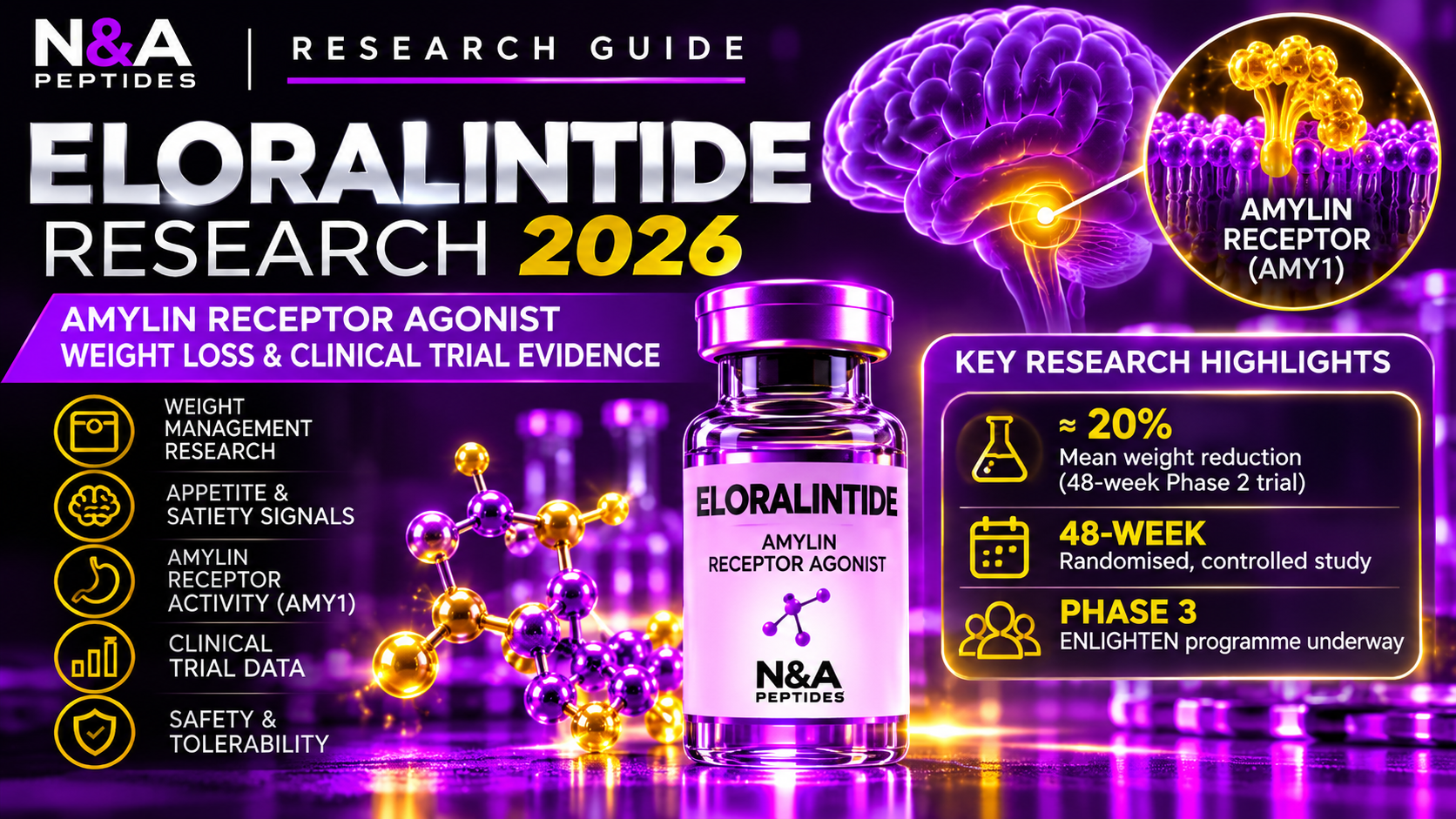
Eloralintide research has become an important area of metabolic science because it investigates a different hormone pathway from the GLP-1 and GIP receptor targets used in several established therapies. Developed by Eli Lilly under the research identifier LY3841136, eloralintide is an investigational, selective amylin receptor agonist. Its 48-week Phase 2 results, published in The Lancet, have generated interest in appetite regulation, satiety signalling and the development of new obesity treatments.
What Is Eloralintide?
Eloralintide is an investigational molecule designed to selectively activate amylin receptors, with particular interest in the AMY1 receptor. Amylin is a peptide hormone released alongside insulin from pancreatic beta cells after meals. It helps coordinate biological signals associated with food intake and feelings of fullness. Activating this pathway may therefore influence eating behaviour and energy intake. Eloralintide is not simply another name for a GLP-1 drug: its principal pharmacological target is different.
Eloralintide Research: How Does the Amylin Pathway Work?
The amylin system is linked to neural circuits involved in meal termination and satiety, including signalling in the brainstem. Researchers are interested in how receptor-selective agonists might influence these circuits while managing tolerability. However, a proposed biological mechanism is not equivalent to proof of clinical safety or benefit in every population.
Amylin Compared With GLP-1 and GIP
GLP-1, GIP and amylin are distinct hormonal signalling systems. This distinction is scientifically useful because investigators can study whether targeting complementary receptors produces different effects when therapies are evaluated independently or in properly designed combination trials.
Eloralintide itself should not be described as a triple agonist; Lilly is separately investigating its combination with tirzepatide, a dual GIP/GLP-1 receptor agonist.
What Did the 48-Week Phase 2 Eloralintide Trial Find?
A randomised, double-blind, placebo-controlled Phase 2 study enrolled 263 adults with obesity, or overweight and at least one weight-related comorbidity, without type 2 diabetes. Participants were assigned to placebo or various eloralintide study arms over 48 weeks. The trial assessed percentage change in body weight from baseline.
- 1 mg study arm: about 9% mean weight reduction in the published efficacy analysis.
- 3 mg arm: about 12% mean reduction.
- 6 mg arm: about 18% mean reduction.
- 9 mg arm: about 20% mean reduction.
- Placebo: approximately 0.4% mean reduction.
These are averages from specific clinical trial arms, not predictions for individuals or instructions on how to use a research material. Importantly, the 9 mg figure was a studied trial-arm level rather than a universal starting level. Trial participants were monitored under a clinical research protocol.
How Should Researchers Interpret the Results?
The 48-week findings support further investigation, but Phase 2 trials are not the same as completed Phase 3 evidence. Outcomes can depend on participant characteristics, analysis method, adherence, attrition and how missing measurements are treated.
Researchers should also distinguish placebo-adjusted effects from the reported change within a treatment group. The study evaluated several dose-escalation schemes, making comparisons between arms more complex than simply ranking the amounts.
What Were the Reported Adverse Events?
The published trial identified nausea and fatigue among commonly reported adverse events, with tolerability varying by treatment arm. Gastrointestinal effects were important enough to investigate different escalation strategies.
The absence of a particular adverse event in a relatively small trial does not establish its absence in broader or longer-term use. Serious, uncommon and delayed effects require larger studies and post-authorisation monitoring where applicable.
Eloralintide Phase 3 Research in 2026
Eloralintide has progressed into Phase 3 clinical research. Lilly lists studies examining obesity, participants with type 2 diabetes and additional populations with related conditions.
The ENLIGHTEN programme is designed to gather larger-scale efficacy and safety data. A registered or recruiting trial is not evidence of a successful outcome; conclusions depend on completed studies and reported results.
Eloralintide and Tirzepatide: Why Study the Combination?
Lilly is also investigating a combination programme called EloraTZP that pairs eloralintide’s selective amylin activity with the GIP/GLP-1 actions of tirzepatide.
The combination is distinct from eloralintide monotherapy. Its findings cannot be treated as evidence that a separately supplied research product will reproduce clinical trial outcomes. Formulation, stability, identity and manufacturing controls also matter.
Research-Grade Material: Identity, Purity and Traceability
For legitimate laboratory studies, researchers assess a peptide’s identity using analytical techniques such as mass spectrometry and examine impurities using appropriate chromatographic methods.
A laboratory report should be interpreted in the context of the tested sample and lot. A purity percentage alone does not demonstrate sterility, endotoxin control, clinical equivalence, safety or regulatory approval.
Explore more educational articles in the N&A Peptides Research Guides, including discussions of peptide mechanisms and laboratory analysis.
Frequently Asked Questions About Eloralintide
Is eloralintide a GLP-1 receptor agonist?
No. It is being developed as a selective amylin receptor agonist. Its research pathway differs from therapies acting primarily on GLP-1 or GIP receptors.
Did trial participants lose 20% of their weight?
The published 48-week Phase 2 trial reported approximately 20% mean weight reduction in one arm. That is a group average, not a guaranteed individual outcome.
Is eloralintide approved as a medicine?
Eloralintide remains investigational as of this guide’s November 2026 review. Phase 3 research is underway.
Does Phase 2 research establish long-term safety?
No. Larger and longer studies are essential to evaluate uncommon risks and benefits in broader populations.
Scientific References and Further Reading
- Billings and colleagues: Eloralintide 48-week Phase 2 randomised trial, The Lancet (PubMed).
- Eli Lilly: What to Know About Eloralintide.
- Eli Lilly Clinical Trials: ENLIGHTEN-2 Phase 3 programme.
- Eli Lilly Clinical Trials: ENLIGHTEN-6.
Conclusion
Eloralintide research highlights the scientific importance of the amylin signalling pathway. Its Phase 2 data provide a reason for further investigation, while open questions about long-term efficacy, safety and combination treatment are being addressed in larger trials.
Clinical outcomes from regulated trials must not be assumed to apply to independently marketed research materials.
Published by N&A Peptides | Scientific research and analytical education.