Blog
NAD+ Research 2026: Cellular Energy, DNA Repair, Mitochondria & Ageing

Research notice: This guide is provided for scientific and educational purposes. NAD+ is a naturally occurring coenzyme, not a peptide. Findings about how NAD+ functions inside cells are not proof that taking or injecting additional NAD+ delivers the same effects. N&A Peptides research products are intended for laboratory research only, not human or veterinary use.
NAD+ research has become a major subject in mitochondrial biology, ageing science and metabolic research. Nicotinamide adenine dinucleotide (NAD+) is present in living cells and is involved in reactions essential to energy metabolism, DNA-damage responses and cellular signalling. Interest has grown because NAD+ metabolism changes under certain conditions, including disease and ageing, and scientists are investigating whether those changes can be modified.
The important distinction is between well-established molecular functions, promising laboratory findings and clinical results in people. This 2026 guide separates those levels of evidence and explains what recent research actually demonstrates.
What Is NAD+?
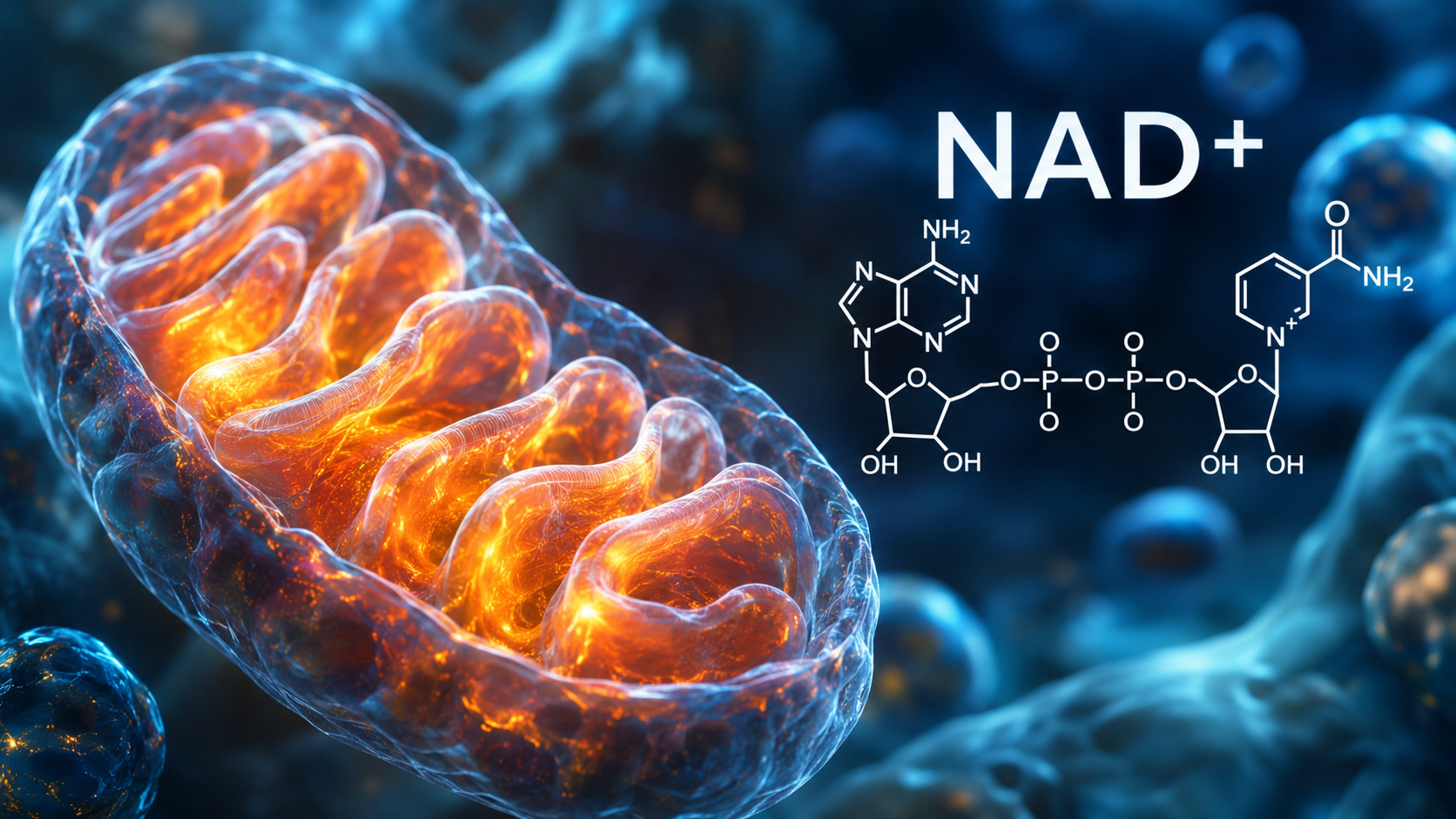
NAD+ stands for nicotinamide adenine dinucleotide. It is a coenzyme: a molecule that helps enzymes perform chemical reactions. Unlike a peptide, which consists of a chain of amino acids, NAD+ is a dinucleotide assembled from nucleotide-related building blocks.
NAD exists in two closely connected forms. NAD+ is the oxidised form; NADH is the reduced form. As electrons move through metabolic pathways, these molecules can convert between one another. This is known as a redox cycle, and it is fundamental to the way cells process nutrients.
NAD+ also acts as a substrate for enzymes that use it during signalling and maintenance processes. This means its biological importance goes well beyond simply being associated with energy production.
How NAD+ Works in Cellular Energy Production
Cells extract chemical energy from carbohydrates, fats and other nutrients through interconnected processes. NAD+ plays an essential role in several of these reactions:
- Glycolysis: NAD+ participates in reactions that help cells process glucose.
- Citric acid cycle: NAD+ accepts electrons as fuel-derived molecules are broken down, becoming NADH.
- Mitochondrial electron transport: NADH transfers electrons into the respiratory chain, contributing to the proton gradient used to make ATP.
- Fatty-acid oxidation: NAD-dependent reactions support the breakdown of fatty acids.
ATP, or adenosine triphosphate, is the cell’s principal immediately usable energy currency. NAD+ does not act as a direct substitute for ATP. Rather, the NAD+/NADH cycle helps metabolism generate ATP efficiently.
A 2025 review in npj Metabolic Health and Disease explains how NAD+ metabolism connects with mitochondrial quality control, oxidative balance and metabolic adaptation. Read the scientific review.
Does more NAD+ automatically mean more energy?
No. A molecule can be essential for normal metabolism without extra amounts automatically improving how someone feels or performs. Cell-specific NAD+ availability, enzyme activity, tissue conditions and the underlying cause of fatigue all matter. Clinical trials have not consistently shown that raising NAD-related biomarkers increases subjective energy or exercise performance.
NAD+ and DNA Repair: The Role of PARP Enzymes
DNA is continually exposed to damage from normal cellular activity and environmental stressors. Cells contain sophisticated systems that detect and respond to this damage.
One family involved in these responses is poly(ADP-ribose) polymerases, usually abbreviated to PARPs. Certain PARP enzymes recognise types of DNA damage and use NAD+ as a source of ADP-ribose units to modify nearby proteins. These signals can help recruit components of the cellular DNA-repair machinery.
The relationship is scientifically important, but it is often overstated in online advertising. NAD+ is involved in DNA-damage responses; that does not mean providing extra NAD+ has been proven to repair DNA more effectively, prevent cancer or reverse ageing in humans. PARP activity is complex, and excessive activation can itself deplete cellular NAD+ under some conditions.
The 2024 Nature Reviews Molecular Cell Biology review discusses the opportunities and challenges in modifying NAD+ pathways. Review the paper.
Sirtuins, Cellular Signalling and Ageing Research
Sirtuins are a family of NAD+-dependent enzymes involved in processes such as protein modification, metabolic regulation and cellular stress responses. Researchers study sirtuins partly because they help coordinate how cells respond to changing nutrient availability and other stresses.
Some sirtuins influence mitochondrial and nuclear proteins, while others participate in the regulation of gene expression and metabolic pathways. Their activity depends on biological context and is not controlled by NAD+ concentration alone.
This has led to interest in whether changing NAD+ availability might affect age-associated cellular processes. However, the presence of a plausible mechanism is not the same as evidence that NAD+ supplementation slows biological ageing or extends human lifespan. At present, those outcomes have not been demonstrated reliably in clinical trials.
Does NAD+ Decline With Age?
Changes in NAD+ metabolism have been observed in ageing models and in selected human tissues. Potential contributors include alterations in synthesis, higher consumption by enzymes such as CD38, inflammation and metabolic stress.
But the statement that “NAD+ always declines with age” is too simple. NAD+ concentrations differ across tissues, compartments and measurement methods. Some human studies report age-associated reductions; others do not show a consistent relationship.
A 2025 Nature Metabolism review concluded that human evidence for a universal age-related fall in NAD+ remains limited and that animal findings cannot be transferred directly to humans. Read the review.
For researchers, the more useful questions are which tissue, which NAD metabolite, which experimental conditions and which outcome measure are being studied.
NAD+, NADH, NMN and NR: What Is the Difference?
These related substances are frequently discussed together but should not be treated as interchangeable.
| Compound | Scientific description | Research distinction |
|---|---|---|
| NAD+ | Oxidised nicotinamide adenine dinucleotide | Central coenzyme and enzyme substrate |
| NADH | Reduced form of NAD+ | Carries electrons during energy metabolism |
| NMN | Nicotinamide mononucleotide | Precursor used in NAD+ synthesis pathways |
| NR | Nicotinamide riboside | Precursor that can be converted through NMN into NAD+ |
| Nicotinamide | Form of vitamin B3 | Recycled through the NAD+ salvage pathway |
The body maintains NAD+ through several pathways, including the salvage pathway, which recycles nicotinamide. The enzyme NAMPT converts nicotinamide into NMN, and NMNAT enzymes participate in the subsequent conversion to NAD+.
This distinction is especially important when interpreting experiments: most human intervention research focuses on oral NR or NMN, not administered NAD+ itself. Evidence for one chemical and delivery route cannot automatically validate another.
What Do Human NAD+ Studies Actually Show in 2026?
The strongest evidence concerns biomarker changes following NAD+ precursor supplementation, rather than proven improvements in longevity, physical performance or disease outcomes.
A 2018 Randomised Study of NR
A small randomised crossover trial published in Nature Communications investigated oral nicotinamide riboside in healthy middle-aged and older adults. The researchers observed increases in NAD-related metabolites in blood cells, demonstrating biological activity. The study was not designed to prove longer-term clinical benefits and did not establish improved exercise performance or overall metabolic health. Read Martens and colleagues (2018).
A 2021 Randomised Study of NMN
A study published in Science examined NMN in women with prediabetes. It reported improved skeletal-muscle insulin sensitivity in the studied population, but those results should not be generalised to all people or to NAD+ itself. It did not demonstrate that NAD+ administration improves insulin sensitivity, and it was not a longevity trial. Read Yoshino and colleagues (2021).
The 2026 Systematic Review
A 2026 systematic review in Ageing Research Reviews analysed 113 eligible studies: 33 human intervention studies and 80 rodent studies. Human trials of oral NAD+ precursors often showed increases in NAD-related biomarkers, but improvements in clinically meaningful metabolic, cardiovascular, functional or wellbeing outcomes were mixed, inconsistent or absent.
Importantly, the reviewers found no eligible clinical outcomes trials evaluating intravenous or intramuscular NAD+ itself for anti-ageing or wellness indications. A pharmacokinetic pilot involving intravenous NAD+ did not provide evidence of clinical effectiveness. The authors concluded that clinical effectiveness for ageing and wellness remains inconclusive. Read the 2026 systematic review.
NAD+ Research: What Is Established and What Is Not?
| Research question | State of evidence |
|---|---|
| NAD+ is essential to cellular redox metabolism | Well established |
| NAD+ participates in mitochondrial energy pathways | Well established |
| PARP and sirtuin enzymes use NAD+ | Well established |
| Oral NR and NMN can increase NAD-related biomarkers | Supported by human trials |
| NAD+ concentrations decline uniformly in every human tissue with age | Not established |
| NAD+ injections improve energy, cognition or exercise performance | Not established by robust clinical trials |
| NAD+ administration repairs DNA or reverses biological ageing in humans | Not established |
| NAD+ administration extends human lifespan | Not established |
| Long-term safety and effectiveness of research-grade NAD+ injection products | Not established |
NAD+ Administration, Safety and Research Limitations
Laboratory use, oral precursor studies and human injections are three different contexts with different quality and safety requirements. Clinical outcomes observed with oral NR or NMN cannot be assumed for an NAD+ pen, infusion or any other delivery format.
Sterility is particularly important for any product intended for injection. The US Food and Drug Administration has warned that non-sterile or food-grade NAD+ ingredients are not suitable for sterile drug compounding without appropriate processing. It reported adverse events following compounded injectable NAD+ products, including severe chills, shaking and vomiting, potentially consistent with endotoxin contamination. Read the FDA safety notice.
A research-grade chemical’s stated identity or purity percentage does not establish sterility, suitability for injection, clinical safety or therapeutic effectiveness. This article does not provide administration, reconstitution or dosage instructions. Anyone seeking medical advice should consult a qualified healthcare professional.
NAD+ Laboratory Analysis and Quality Documentation
Reliable analytical research depends on accurate compound identification, batch records and appropriately selected testing methods. Techniques such as high-performance liquid chromatography (HPLC) and mass spectrometry (MS) can be relevant to examining sample composition, identity and degradation, depending on the analytical procedure.
Scientists should distinguish between assay results for chemical identity, content or concentration, chromatographic purity, microbial contamination and endotoxins. A result under one category cannot substitute for testing under another. For example, a favourable chromatographic purity result does not show that a material is sterile.
For further background, see our guide to understanding a Certificate of Analysis and our Research Guides library. The N&A Peptides NAD+ 1000mg pen listing provides product-format information for laboratory researchers; the listing should not be interpreted as evidence of clinical effectiveness or suitability for human use.
NAD+ and MOTS-C: Related Research, Different Molecules
NAD+ and MOTS-C are both discussed in mitochondrial research, but they are not the same type of molecule. NAD+ is a cellular coenzyme; MOTS-C is a mitochondrial-derived peptide investigated for signalling related to metabolism and cellular stress.
Both fields raise interesting questions about mitochondrial function and ageing biology, but evidence from one cannot be used to establish benefits for the other. Explore our separate MOTS-C research guide for a closer look at mitochondrial-derived peptide signalling.
Frequently Asked Questions About NAD+ Research
Is NAD+ a peptide?
No. NAD+ is a dinucleotide coenzyme. Peptides are chains of amino acids. NAD+ may be stocked alongside peptide research materials, but its chemical classification is different.
What does NAD+ do in the body?
NAD+ participates in redox reactions that support metabolism and provides a substrate for enzymes involved in cellular signalling, protein modification and DNA-damage responses.
Is NAD+ the same as vitamin B3?
No. Forms of vitamin B3, including nicotinamide and nicotinic acid, contribute to pathways that produce NAD+. They are precursors or related nutrients, not chemically identical to NAD+.
Does NAD+ improve energy levels?
NAD+ is essential to normal energy metabolism, but administering extra NAD+ has not been shown convincingly to improve subjective energy, fatigue or exercise performance in high-quality human clinical trials.
Does NAD+ repair DNA?
NAD+ is used by enzymes involved in DNA-damage signalling and repair processes. That does not prove that NAD+ supplementation improves DNA repair outcomes or prevents disease in people.
Is NAD+ anti-ageing?
Its involvement in cellular ageing mechanisms is well documented. However, there is no convincing evidence that administering NAD+ reverses ageing or extends human life.
Are NAD+ injections proven safe and effective?
No. High-quality clinical outcome evidence remains limited, and research-grade preparations must not be equated with authorised sterile medicines. Contamination and quality-control risks are important considerations.
Conclusion: Where NAD+ Research Goes Next
NAD+ remains one of the most important molecules in cellular metabolism. Its established roles in energy pathways, PARP activity, sirtuin biology and mitochondrial function make it a significant subject for scientific investigation.
Research into NAD+ precursors has demonstrated that NAD-related biomarkers can be changed in humans. What remains uncertain is whether those changes produce reliable, clinically meaningful improvements in health, ageing or longevity—and whether any findings can be extended to NAD+ administered directly.
Future progress will depend on better tissue-specific measurements, larger randomised clinical studies, clear outcomes and rigorous evaluation of product quality and safety. For researchers following this field, separating biological plausibility from proven clinical benefit is essential.
Research-use disclaimer: This article is for education and scientific research only. N&A Peptides products are supplied strictly for laboratory use and are not intended for human or veterinary consumption, injection, diagnosis, prevention or treatment of disease.
Scientific References
- Yusri K, et al. (2025). The role of NAD+ metabolism and its modulation of mitochondria in aging and disease. npj Metabolic Health and Disease. Full text.
- Migaud ME, Ziegler M, Baur JA. (2024). Regulation of and challenges in targeting NAD+ metabolism. Nature Reviews Molecular Cell Biology. Full text.
- Vinten KT, et al. (2025). NAD+ precursor supplementation in human ageing: clinical evidence and challenges. Nature Metabolism. PubMed.
- Gallagher C, Emmanuel OO. (2026). NAD+ supplementation for anti-aging and wellness: A PRISMA-guided systematic review of preclinical and clinical evidence. Ageing Research Reviews. PubMed.
- Martens CR, et al. (2018). Chronic nicotinamide riboside supplementation is well-tolerated and elevates NAD+ in healthy middle-aged and older adults. Nature Communications. PubMed.
- Yoshino M, et al. (2021). Nicotinamide mononucleotide increases muscle insulin sensitivity in prediabetic women. Science. PubMed.
- US FDA. FDA reminds compounders to use ingredients suitable for sterile compounding. Safety notice.