Blog
Retatrutide vs Tirzepatide 2026: Clinical Trials, Weight Loss & Key Differences

Updated: 8 November 2026 | N&A Peptides Research Guides
Research notice: This article is provided for scientific and educational purposes only. It does not provide medical advice, treatment recommendations or dosage instructions. Retatrutide remains an investigational medicine and is not authorised for human use in the UK. Tirzepatide is a prescription-only medicine for specific approved indications.
Retatrutide vs tirzepatide has become an important comparison in modern metabolic research. Both compounds act on hormone receptors involved in appetite regulation, glucose metabolism and energy balance, but their mechanisms are not identical.
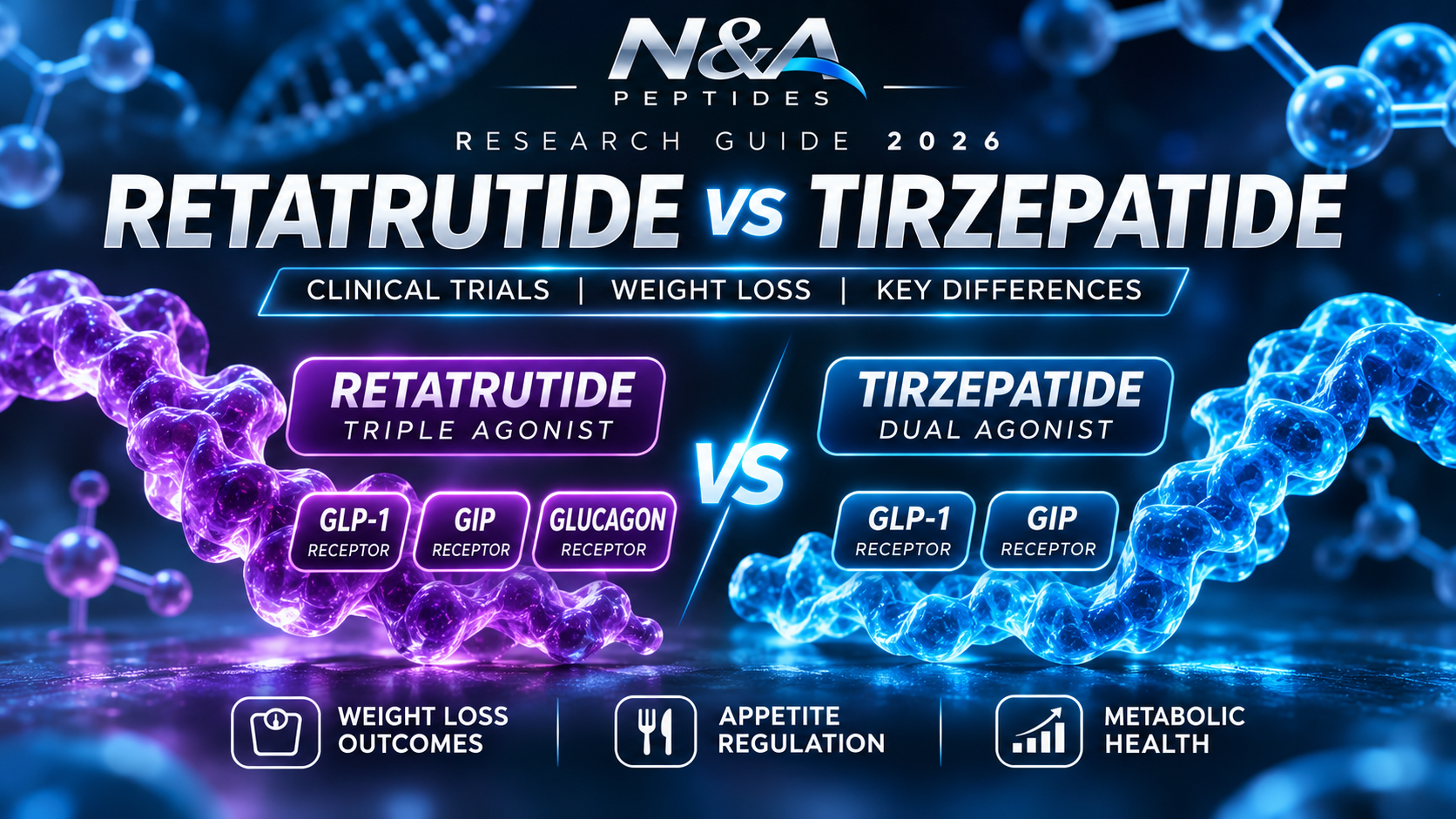
Tirzepatide, commercially known as Mounjaro in the United Kingdom, activates two receptors: GLP-1 and GIP. Retatrutide activates those same two receptors alongside a third, the glucagon receptor.
This difference has attracted significant scientific interest, particularly following the publication of new Phase 3 retatrutide clinical trial results in September 2026.
But does the additional receptor translate into superior clinical results? What does the published evidence show, and what remains unknown?
This N&A Peptides research guide examines the molecular differences, major clinical trials, reported weight-loss outcomes, safety findings and regulatory status of both compounds as of November 2026.
Retatrutide vs Tirzepatide: Quick Comparison
Although both molecules belong to the expanding field of incretin-based metabolic research, they differ in several important ways.
| Feature | Retatrutide | Tirzepatide |
|---|---|---|
| Development name | LY3437943 | LY3298176 |
| Receptor activity | GLP-1, GIP and glucagon | GLP-1 and GIP |
| Scientific classification | Triple receptor agonist | Dual receptor agonist |
| Additional glucagon activity | Yes | No direct glucagon receptor agonism |
| Developer | Eli Lilly | Eli Lilly |
| UK regulatory status | Investigational; not authorised | Authorised for specified indications |
| Major obesity trial | TRIUMPH-1 | SURMOUNT-1 |
| Direct comparison trial | TRIUMPH-5; results not yet published | |
The principal distinction: retatrutide activates three metabolic receptor pathways, whereas tirzepatide activates two. This changes the pharmacological research questions surrounding each compound, but receptor count alone does not determine clinical superiority.
What Is Retatrutide?
Retatrutide is an investigational peptide-based compound developed by Eli Lilly. It is designed to activate three hormone receptor systems associated with metabolic regulation:
- GLP-1: Influences glucose-dependent insulin secretion, gastric function and appetite-related signalling.
- GIP: Participates in nutrient-responsive insulin secretion and metabolic regulation.
- Glucagon: Influences hepatic glucose metabolism, nutrient utilisation and energy balance.
Retatrutide is known as a triple agonist because a single molecule activates all three receptors.
Early clinical investigations demonstrated substantial effects on body-weight outcomes. More recently, larger Phase 3 investigations have expanded the evidence base, allowing scientists to assess its effects in broader clinical populations.
Researchers are particularly interested in understanding how adding glucagon receptor activity changes the overall metabolic profile compared with dual-receptor agonism.
For a detailed explanation of the individual pathways and clinical development programme, read our Retatrutide Research 2026: Triple Agonist Explained guide.
What Is Tirzepatide?
Tirzepatide is a dual GLP-1 and GIP receptor agonist developed by Eli Lilly. It is an authorised prescription medicine in the United Kingdom, marketed under the brand name Mounjaro.
Unlike retatrutide, tirzepatide does not directly activate the glucagon receptor as part of its intended pharmacological mechanism.
Instead, it combines activity at two incretin-related receptors within a single peptide molecule.
Incretins are hormones involved in the body’s response to food consumption. Their signalling influences insulin secretion, blood glucose regulation and appetite-related pathways.
Tirzepatide has undergone extensive clinical investigation through the SURPASS and SURMOUNT programmes, which have examined metabolic and weight-management outcomes in different participant populations.
Its approved status means it has undergone regulatory assessment for specific medical uses. However, this does not mean it is suitable for everyone or that research-grade tirzepatide products are equivalent to licensed Mounjaro.
Explore our Tirzepatide Research Guide 2026 for further information about its dual-receptor mechanism and clinical evidence.
How Do Retatrutide and Tirzepatide Work Differently?
The central scientific difference lies in the additional glucagon receptor activity associated with retatrutide.
1. GLP-1 Receptor Activation
Both compounds activate the glucagon-like peptide-1 receptor.
GLP-1 is a naturally occurring hormone released in response to nutrient intake. It participates in glucose-dependent insulin secretion and communicates with neural pathways involved in appetite and satiety.
GLP-1 receptor agonism can also influence gastric emptying, contributing to the physiological effects observed during clinical trials.
Because both molecules share this receptor target, they have some overlapping pharmacological characteristics.
2. GIP Receptor Activation
Both tirzepatide and retatrutide activate the glucose-dependent insulinotropic polypeptide receptor.
GIP is another hormone associated with the body’s response to food.
Its biological functions include influencing pancreatic insulin secretion when blood glucose is elevated, alongside signalling in other metabolically active tissues.
Research into combined GLP-1 and GIP agonism investigates how these two receptor systems interact and whether targeting both produces effects that differ from GLP-1 activation alone.
This dual mechanism is fundamental to tirzepatide’s pharmacology and forms part of retatrutide’s triple-receptor mechanism.
3. Glucagon Receptor Activation
The most significant difference is that retatrutide also activates the glucagon receptor.
Glucagon is commonly associated with increasing blood glucose through effects on the liver, but glucagon receptor signalling is also involved in broader aspects of energy metabolism.
Investigators are studying whether the addition of glucagon receptor agonism can influence:
- Whole-body energy expenditure and energy balance.
- Hepatic nutrient metabolism.
- Substrate utilisation, including aspects of fat metabolism.
- Interactions between appetite regulation and metabolic activity.
- Changes in cardiometabolic biomarkers.
The contribution of glucagon receptor activation to retatrutide’s observed clinical outcomes is still being investigated.
It would therefore be inaccurate to conclude that retatrutide must be more effective simply because it activates a third receptor.
Retatrutide vs Tirzepatide: Clinical Trial Results
Clinical trials offer the most meaningful evidence for examining the effects of these compounds.
However, an important distinction must be made: results from separate studies cannot establish which treatment performs better in a direct comparison.
Different participant populations, treatment durations, statistical methods and trial protocols can affect reported outcomes.
Retatrutide Phase 2 Trial: Results Published in 2023
A Phase 2 retatrutide study published in the New England Journal of Medicine in June 2023 included 338 adults with obesity or overweight accompanied by a weight-related condition.
The randomised, placebo-controlled investigation examined changes in body weight over 48 weeks.
Reported mean weight changes at 48 weeks included:
- Combined 4 mg groups: approximately 17.1% reduction.
- Combined 8 mg groups: approximately 22.8% reduction.
- 12 mg group: approximately 24.2% reduction.
- Placebo: approximately 2.1% reduction.
These were outcomes under controlled clinical-trial conditions and should not be interpreted as administration recommendations.
The study provided important early evidence for triple-receptor agonism, while also identifying adverse events requiring further evaluation.
Scientific source: Jastreboff and colleagues, 2023 – Retatrutide Phase 2 Obesity Trial.
Retatrutide Phase 3: TRIUMPH-1 Results in 2026
A major development occurred in September 2026 when results from the TRIUMPH-1 Phase 3 trial were published in the New England Journal of Medicine.
This randomised, double-blind study included 2,339 participants with obesity and without diabetes.
Participants were evaluated over an 80-week treatment period.
Under the treatment-regimen analysis, the published results reported the following mean body-weight changes:
| Study group | Mean weight change | Duration |
|---|---|---|
| Retatrutide 4 mg | -17.6% | 80 weeks |
| Retatrutide 9 mg | -23.7% | 80 weeks |
| Retatrutide 12 mg | -25.0% | 80 weeks |
| Placebo | -3.9% | 80 weeks |
These findings represented an important step forward from the earlier, smaller Phase 2 study.
TRIUMPH-1 also investigated outcomes involving knee osteoarthritis and obstructive sleep apnoea in particular participant subgroups.
Other analyses of the same trial have reported different percentage estimates because they use different statistical assumptions about treatment adherence and other events occurring during the trial.
For example, an efficacy-estimand analysis reported 28.3% mean weight reduction in the 12 mg group. That figure should not be substituted for the 25.0% treatment-regimen result without explaining the different analysis.
Scientific source: TRIUMPH-1 Phase 3 Results, New England Journal of Medicine, 2026.
Tirzepatide Phase 3: SURMOUNT-1 Results
The SURMOUNT-1 clinical trial investigated tirzepatide in adults with obesity or overweight and a weight-related complication, excluding participants with diabetes.
Published in the New England Journal of Medicine in 2022, the study included 2,539 participants and evaluated outcomes over 72 weeks.
Under the treatment-regimen analysis, reported mean body-weight changes were:
| Study group | Mean weight change | Duration |
|---|---|---|
| Tirzepatide 5 mg | -15.0% | 72 weeks |
| Tirzepatide 10 mg | -19.5% | 72 weeks |
| Tirzepatide 15 mg | -20.9% | 72 weeks |
| Placebo | -3.1% | 72 weeks |
The trial demonstrated substantial average weight reduction within the studied population and contributed to the clinical evidence supporting tirzepatide’s development.
As with retatrutide, results varied according to the analysis approach, treatment group and participant characteristics.
Scientific source: SURMOUNT-1 Trial, New England Journal of Medicine, 2022.
Which Shows Greater Weight Loss in Published Research?
When viewing headline results, retatrutide’s Phase 3 TRIUMPH-1 trial reported a 25.0% mean reduction at 80 weeks in its highest studied group, while the SURMOUNT-1 tirzepatide trial reported 20.9% at 72 weeks in its highest studied group.
Both figures use treatment-regimen analyses, but the studies were not designed to compare the compounds directly.
The trials differed in several ways:
- Duration: TRIUMPH-1 lasted 80 weeks, while SURMOUNT-1 lasted 72 weeks.
- Participants: The baseline characteristics and eligibility criteria were not identical.
- Study protocols: Treatment escalation, monitoring and trial procedures differed.
- Placebo responses: Different control-group responses influence the interpretation of treatment effects.
- Statistical analysis: Handling of treatment discontinuation and missing data can influence estimates.
Consequently, the larger numerical reduction in the retatrutide trial is an interesting finding, but it is not proof that retatrutide is superior to tirzepatide.
That question requires a randomised head-to-head trial involving both compounds.
TRIUMPH-5: The Direct Retatrutide vs Tirzepatide Trial
One of the most important ongoing studies is TRIUMPH-5, registered as NCT06662383.
Unlike the separate TRIUMPH-1 and SURMOUNT-1 investigations, TRIUMPH-5 has been specifically designed to compare retatrutide and tirzepatide within the same clinical-trial framework.
The Phase 3 study is investigating approximately 800 adults with obesity.
Its primary outcome is the percentage change in body weight from baseline to week 80.
Additional outcomes include measures involving waist circumference, body mass index, blood pressure, cholesterol, triglycerides and glycaemic biomarkers.
As of 8 November 2026, the trial is listed as active but not recruiting, with completion expected later in 2026. No peer-reviewed head-to-head outcome results have been published.
Researchers will be particularly interested in whether the trial demonstrates a statistically significant difference between the compounds, and whether any efficacy difference is accompanied by important safety or tolerability differences.
Official study record: TRIUMPH-5 – ClinicalTrials.gov.
What About Type 2 Diabetes and Glucose Regulation?
Both compounds are investigated in metabolic conditions involving insulin signalling and glucose regulation.
Tirzepatide already has a substantial clinical evidence base in people with type 2 diabetes, developed through the SURPASS programme.
Its activation of GLP-1 and GIP receptors influences glucose-dependent insulin secretion and broader metabolic responses.
Retatrutide is also undergoing clinical evaluation in people with type 2 diabetes.
In July 2026, Eli Lilly reported positive topline findings from the Phase 3 TRIUMPH-2 programme involving adults with obesity or overweight and type 2 diabetes.
The company reported average weight reduction of up to 20.8% at 80 weeks in the investigated population, alongside changes in HbA1c.
These findings add to the evidence for retatrutide but should be interpreted in the context of the study’s population and analysis methods. They do not constitute a direct comparison with tirzepatide.
Further research: Eli Lilly clinical development updates.
Retatrutide vs Tirzepatide: Side Effects and Safety
Safety is an essential part of evaluating any metabolic treatment.
Both compounds have been associated with gastrointestinal adverse events in clinical trials.
Commonly reported reactions include:
- Nausea.
- Diarrhoea.
- Vomiting.
- Constipation.
- Abdominal discomfort.
These findings reflect clinical-trial observations, not a guarantee that every participant will experience the same effects.
Retatrutide Safety Findings
TRIUMPH-1 reported gastrointestinal symptoms as common adverse events, with frequencies varying between treatment groups.
Additional reported events included dysaesthesia, a term describing altered or unusual sensations, and urinary tract infections.
Earlier Phase 2 research identified dose-dependent increases in heart rate that peaked during the study and subsequently declined.
Questions about longer-term tolerability, rare adverse events and cardiovascular outcomes remain important research priorities.
Tirzepatide Safety Findings
Tirzepatide has a more established clinical safety and regulatory evidence base because it has undergone extensive Phase 3 development and is already authorised for specific uses.
However, authorised status does not mean that it is free from risk.
Its prescribing information includes important warnings and precautions, including gastrointestinal adverse reactions and the potential for pancreatitis.
The UK Medicines and Healthcare products Regulatory Agency has issued safety communications concerning GLP-1 medicines and strengthened warnings regarding acute pancreatitis.
Anyone considering prescription treatment should obtain guidance from an appropriate healthcare professional.
UK safety information: MHRA Guidance on GLP-1 Medicines.
Is Retatrutide Approved in the UK in 2026?
No. As of November 2026, retatrutide has not been authorised as a medicine for use in the United Kingdom.
Although Phase 3 findings have been published, successful clinical-trial results do not automatically create marketing authorisation.
Regulators must evaluate evidence relating to quality, clinical efficacy and safety before deciding whether a medicine can be approved for particular indications.
The MHRA has warned that products marketed as retatrutide outside legitimate clinical trials are being supplied illegally and may present serious public-health risks.
The designation “research use only” does not automatically make the supply of an unauthorised medicine lawful.
Tirzepatide, by contrast, is authorised in the UK for specified medical indications and must be obtained through the appropriate prescription and pharmacy channels.
Research materials sold online should not be assumed to be equivalent to licensed pharmaceutical products.
UK regulatory reference: MHRA Statement on Unauthorised Retatrutide Products, October 2026.
Why Analytical Testing Matters in Peptide Research
Both retatrutide and tirzepatide are peptide-based molecules, making reliable chemical characterisation important in legitimate laboratory investigations.
When researchers investigate a synthetic peptide, the analytical documentation should help establish whether a sample corresponds to its intended molecular identity.
Several testing approaches may be used.
High-Performance Liquid Chromatography (HPLC)
HPLC separates chemical components based on their behaviour within a chromatographic system.
When an appropriate analytical method has been developed, researchers can use chromatographic data to investigate sample composition and certain forms of purity.
However, an HPLC purity percentage does not independently establish sterility, freedom from endotoxins or clinical safety.
Liquid Chromatography–Mass Spectrometry (LC-MS)
LC-MS combines chromatographic separation with mass spectrometric detection.
It can support molecular identification and help investigate components present within a sample.
Reliable interpretation depends on the testing method and the chemical characteristics of the molecule being investigated.
Certificates of Analysis
A Certificate of Analysis, or COA, documents results obtained from specified tests on a sample or batch.
Researchers should examine the methods used, the identity of the tested material, and which characteristics have actually been assessed.
Chemical purity, microbial testing, sterility and endotoxin testing are different analytical questions. None should be assumed from the result of another.
Importantly, a COA cannot replace regulatory authorisation or establish that a research-grade material is safe for administration.
Explore more scientific and laboratory-quality topics in the N&A Peptides Research Guides library.
Frequently Asked Questions
Is retatrutide the same as tirzepatide?
No. They are different molecules. Tirzepatide activates GLP-1 and GIP receptors, whereas retatrutide additionally activates the glucagon receptor.
What is the biggest difference between retatrutide and tirzepatide?
The main pharmacological difference is receptor activity. Retatrutide is a triple agonist targeting GLP-1, GIP and glucagon receptors; tirzepatide is a dual agonist targeting GLP-1 and GIP receptors.
Is retatrutide stronger than tirzepatide?
Separate retatrutide trials have reported larger numerical average weight reductions than some tirzepatide trials. However, those results cannot establish superiority because the studies were conducted independently. Results from the direct TRIUMPH-5 comparison are needed.
What is the triple agonist peptide?
Retatrutide is an investigational triple hormone receptor agonist that activates GLP-1, GIP and glucagon receptors.
Is retatrutide known as GLP-3?
Retatrutide is sometimes informally described online as GLP-3, but this is not an established scientific name. The accurate description is a GLP-1, GIP and glucagon receptor triple agonist.
What did retatrutide Phase 3 trials show in 2026?
The peer-reviewed TRIUMPH-1 trial reported mean body-weight changes of -17.6%, -23.7% and -25.0% in its three retatrutide groups at 80 weeks, compared with -3.9% for placebo, under the treatment-regimen analysis.
What did the tirzepatide SURMOUNT-1 trial show?
SURMOUNT-1 reported mean body-weight changes of -15.0%, -19.5% and -20.9% in its tirzepatide groups at 72 weeks, compared with -3.1% for placebo, under the treatment-regimen analysis.
Has retatrutide been compared directly with tirzepatide?
TRIUMPH-5 is an active Phase 3 trial specifically designed to compare the compounds. As of 8 November 2026, peer-reviewed results from this direct comparison have not been published.
Is retatrutide available on the NHS?
No. Retatrutide is not an authorised UK medicine. Legitimate access for human administration is currently restricted to appropriately authorised clinical research.
Can research peptides replace prescription medicines?
No. Research-grade peptides should not be treated as substitutes for licensed pharmaceutical products. Their identity or analytical purity does not establish clinical safety, sterility, efficacy or regulatory approval.
Conclusion: What Does the Research Show?
The retatrutide vs tirzepatide comparison highlights an important area of development in metabolic medicine.
Tirzepatide represents established dual GLP-1 and GIP receptor agonism, supported by extensive clinical trials and regulatory approval for specific indications.
Retatrutide represents an investigational triple-receptor approach combining GLP-1, GIP and glucagon receptor activity.
Published clinical trials have reported substantial average weight reductions with both compounds.
However, understanding the significance of those findings requires careful attention to study design, participant populations, treatment duration, statistical methods and safety outcomes.
The forthcoming results from TRIUMPH-5 will be particularly important because they are intended to address the direct comparison question.
Until those results are available, it is scientifically appropriate to describe retatrutide’s Phase 3 outcomes as promising without declaring it definitively superior to tirzepatide.
For further reading, explore our Retatrutide Research Guide, Tirzepatide Research Guide and wider Research Guides collection.
Scientific References
- Jastreboff AM, et al. (2023). Triple-Hormone-Receptor Agonist Retatrutide for Obesity — A Phase 2 Trial. New England Journal of Medicine. DOI: 10.1056/NEJMoa2301972.
- Jastreboff AM, et al. (2026). Retatrutide, a Triple Hormone Receptor Agonist, for Treatment of Obesity. New England Journal of Medicine. DOI: 10.1056/NEJMoa2604169.
- Jastreboff AM, et al. (2022). Tirzepatide Once Weekly for the Treatment of Obesity. New England Journal of Medicine. DOI: 10.1056/NEJMoa2206038.
- Aronne LJ, et al. (2025). Tirzepatide as Compared with Semaglutide for the Treatment of Obesity. New England Journal of Medicine. PubMed.
- ClinicalTrials.gov. TRIUMPH-5: A Study of Retatrutide Compared to Tirzepatide in Adults Who Have Obesity. NCT06662383. Official trial record.
- Eli Lilly and Company (2026). TRIUMPH-1 Phase 3 Clinical Trial Results. Clinical results announcement.
- Medicines and Healthcare products Regulatory Agency (2026). GLP-1 Medicines for Weight Loss and Diabetes: What You Need to Know. UK government guidance.
- Medicines and Healthcare products Regulatory Agency (2026). Counterfeit Weight-Loss Pens and Unauthorised Retatrutide Supply. MHRA regulatory announcement.
Final research disclaimer: This article is intended for scientific education and discussion of published clinical evidence. It is not medical advice or an endorsement of unapproved medicines. Laboratory research products must not be used for human or veterinary administration. The supply of unlicensed medicinal products is subject to UK law, irrespective of research-use labelling.