Blog
Tirzepatide Research Guide 2026

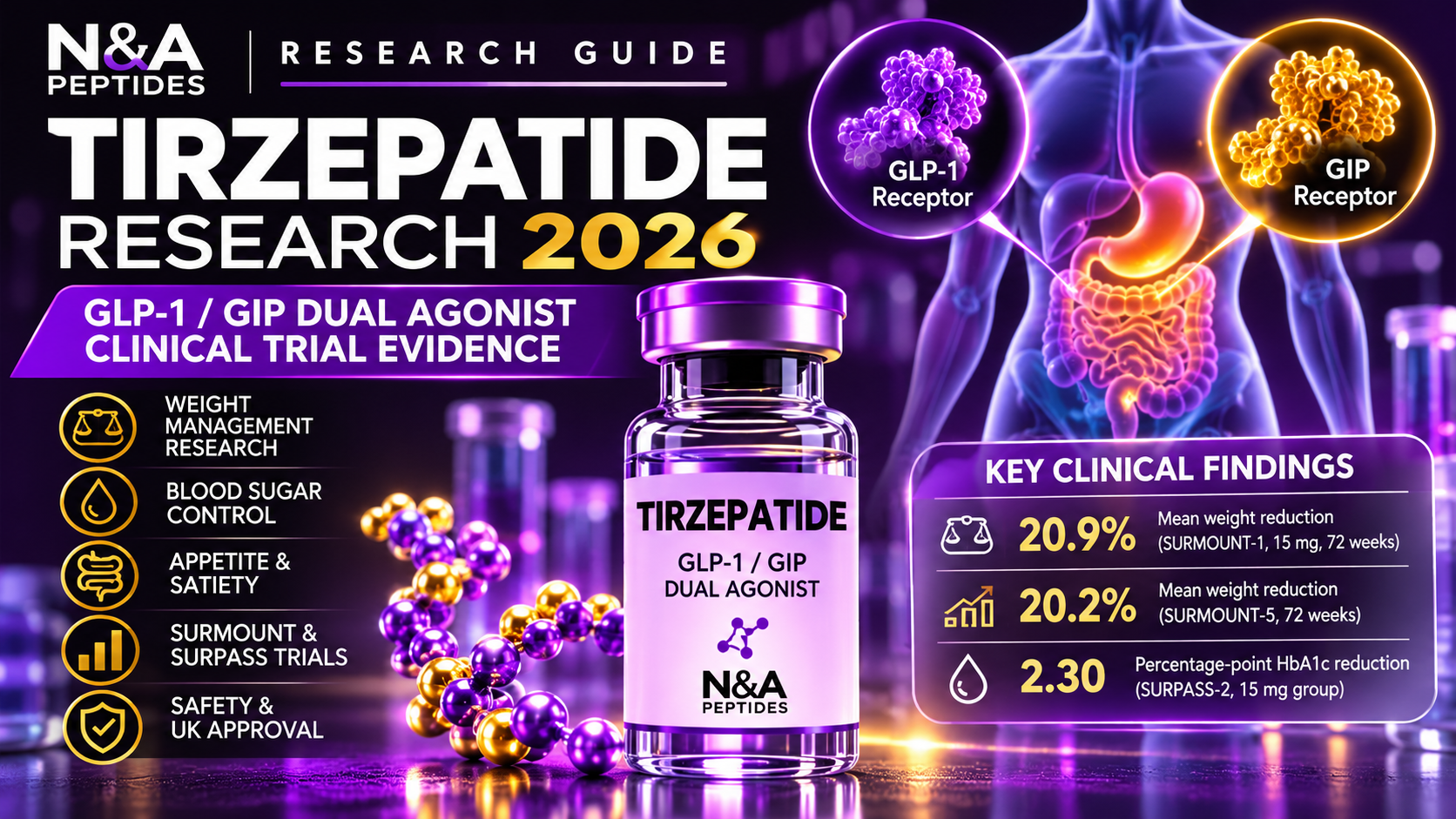
Tirzepatide Research 2026: GLP-1, GIP, Weight Management and Clinical Evidence
Tirzepatide research has become one of the most significant areas of modern metabolic science. As a dual glucose-dependent insulinotropic polypeptide (GIP) and glucagon-like peptide-1 (GLP-1) receptor agonist, tirzepatide has demonstrated clinically meaningful effects on blood glucose regulation, appetite and body weight in large randomised human studies.
Developed by Eli Lilly and marketed as Mounjaro in the United Kingdom, tirzepatide represents an important development in treatments targeting multiple metabolic hormone receptors.
Major clinical programmes, including SURPASS and SURMOUNT, have investigated its effectiveness in type 2 diabetes, obesity and related metabolic conditions.
This N&A Peptides guide explores the science behind tirzepatide, its dual-receptor mechanism, major clinical trial results, comparisons with semaglutide and retatrutide, and important regulatory and safety considerations.
What Is Tirzepatide?
Tirzepatide is a synthetic peptide-based medicine designed to activate two hormone receptors involved in metabolic regulation.
It consists of 39 amino acids and incorporates structural modifications that extend its activity in the body.
The compound interacts with:
- GIP receptors: Involved in glucose-dependent insulin secretion and metabolic signalling.
- GLP-1 receptors: Involved in insulin secretion, glucagon regulation, appetite and gastrointestinal function.
These receptors participate in the incretin system, a group of hormonal pathways that help the body respond to food consumption.
Tirzepatide research is particularly interesting because it combines both receptor activities within a single molecule.
How Does Tirzepatide Work?
Understanding the mechanism of tirzepatide requires examining how the body’s incretin hormones influence blood glucose and energy balance.
1. GLP-1 Receptor Activation
GLP-1 is a naturally occurring hormone released from intestinal cells in response to food.
It contributes to several important processes:
- Stimulating glucose-dependent insulin secretion.
- Reducing inappropriate glucagon secretion when blood glucose is elevated.
- Slowing gastric emptying.
- Increasing sensations of fullness.
- Influencing appetite-related pathways in the brain.
These effects contribute to improved glucose regulation and reduced food intake in appropriate clinical settings.
2. GIP Receptor Activation
GIP is another incretin hormone released following nutrient ingestion.
Its established functions include stimulating insulin secretion in response to elevated glucose.
GIP signalling also interacts with adipose tissue and other metabolic pathways.
Scientists continue to investigate how combined GIP and GLP-1 receptor activation produces the effects observed with tirzepatide.
The contribution of each receptor to appetite control and weight reduction is complex and not completely understood.
3. Dual-Receptor Metabolic Signalling
The distinguishing feature of tirzepatide is its simultaneous activation of GIP and GLP-1 receptors.
Clinical research demonstrates that the resulting pharmacological activity can produce substantial changes in body weight and glycated haemoglobin (HbA1c).
However, dual-receptor activity does not guarantee identical results in every patient. Responses vary with clinical characteristics, treatment tolerability and other factors.
Tirzepatide Research: Five Important Clinical Trial Findings
Several large, controlled clinical trials provide the foundation for understanding the evidence surrounding tirzepatide.
Finding 1: SURMOUNT-1 Demonstrated Substantial Weight Reduction
SURMOUNT-1 was a Phase 3 randomised, double-blind, placebo-controlled study involving 2,539 adults with obesity or overweight and at least one weight-related complication, excluding diabetes.
Participants received assigned treatment alongside lifestyle interventions over 72 weeks.
The study reported the following average changes in body weight:
| Trial group | Mean weight change at 72 weeks |
|---|---|
| Tirzepatide 5 mg | -15.0% |
| Tirzepatide 10 mg | -19.5% |
| Tirzepatide 15 mg | -20.9% |
| Placebo | -3.1% |
All three tirzepatide groups demonstrated statistically greater average weight reduction than placebo.
The results represented an important milestone in clinical research examining incretin-based treatments for obesity.
The percentages describe average outcomes across study groups and should not be interpreted as guaranteed individual results.
Read the SURMOUNT-1 trial in the New England Journal of Medicine.
Finding 2: SURMOUNT-5 Compared Tirzepatide With Semaglutide
The SURMOUNT-5 clinical trial directly compared tirzepatide with semaglutide in adults with obesity or overweight and a weight-related complication, without type 2 diabetes.
The Phase 3b trial included 751 randomised participants and evaluated outcomes over 72 weeks.
Both medicines were administered at maximum tolerated doses within their respective trial protocols.
The published results demonstrated:
- 20.2% mean weight reduction with tirzepatide.
- 13.7% mean weight reduction with semaglutide.
- Mean waist circumference reduction of 18.4 cm with tirzepatide.
- Mean waist circumference reduction of 13.0 cm with semaglutide.
The difference in average weight reduction was statistically significant.
These findings supported the conclusion that tirzepatide produced greater average weight reduction than semaglutide under the specific conditions investigated.
The trial was open-label, meaning participants and investigators knew which treatment was assigned. This is a relevant consideration when interpreting the study design.
Read the SURMOUNT-5 publication on PubMed.
Finding 3: SURPASS-2 Demonstrated Improvements in HbA1c
The SURPASS clinical programme focused primarily on type 2 diabetes and glucose management.
In SURPASS-2, researchers compared tirzepatide with semaglutide 1 mg in adults whose type 2 diabetes was inadequately controlled with metformin.
The trial evaluated changes in HbA1c over 40 weeks.
HbA1c is a measurement reflecting average blood glucose levels over approximately two to three months.
The published mean HbA1c reductions were:
- Tirzepatide 5 mg: 2.01 percentage points.
- Tirzepatide 10 mg: 2.24 percentage points.
- Tirzepatide 15 mg: 2.30 percentage points.
- Semaglutide 1 mg: 1.86 percentage points.
All three tirzepatide groups demonstrated greater average HbA1c reductions than the semaglutide comparator.
It is important not to confuse this diabetes study with SURMOUNT-5, which evaluated different semaglutide doses in a population without diabetes.
Read the SURPASS-2 clinical trial.
Finding 4: Tirzepatide Research Demonstrated Changes in Waist Circumference
Body weight is only one measure used in metabolic research.
Waist circumference provides additional information about changes in abdominal size and can be associated with cardiometabolic risk.
In SURMOUNT-1, mean waist circumference reductions at 72 weeks were approximately:
- 14.0 cm in the 5 mg group.
- 17.7 cm in the 10 mg group.
- 18.5 cm in the 15 mg group.
- 4.0 cm in the placebo group.
Although these findings are substantial, waist circumference alone cannot establish the precise distribution of visceral and subcutaneous fat.
Specialised imaging methods are required to distinguish different abdominal fat compartments accurately.
Finding 5: Continued Treatment and Long-Term Outcomes Matter
Tirzepatide research has also examined what happens when participants discontinue active treatment.
The SURMOUNT-4 withdrawal trial investigated weight changes among participants who initially received tirzepatide and were subsequently assigned either to continue treatment or switch to placebo.
Participants who discontinued active treatment experienced substantial average weight regain, while those continuing treatment experienced further average weight reduction.
This finding is consistent with obesity being a chronic condition that may require long-term management.
It also demonstrates why short-term changes in body weight should not automatically be interpreted as permanent outcomes.
The decision to continue, modify or discontinue prescription treatment requires individual clinical assessment.
Tirzepatide and Appetite Regulation Research
One important aspect of tirzepatide research concerns how incretin receptor signalling influences appetite and food intake.
GLP-1 receptor activation affects neural pathways associated with satiety, including signalling involving the hypothalamus and other brain regions.
Changes in gastric emptying may also contribute to sensations of fullness.
Clinical studies demonstrate that tirzepatide can reduce appetite and food consumption, although the exact contribution of GIP receptor activation remains under investigation.
Researchers are continuing to explore how hormonal signalling affects food reward, meal size and long-term energy balance.
These mechanisms should not be reduced to the claim that the medicine simply prevents hunger. Appetite regulation involves interacting biological and behavioural processes.
Tirzepatide and Cardiometabolic Research
Metabolic clinical trials commonly examine more than body weight and glucose control.
Additional measurements can include blood pressure, lipid profiles, waist circumference and indicators of cardiovascular risk.
SURMOUNT-1 reported improvements across several prespecified cardiometabolic measures.
However, changes in surrogate biomarkers must be distinguished from demonstrated reductions in clinical events such as heart attacks or strokes.
Cardiovascular outcome studies are particularly important because they evaluate events that matter directly to patient health.
Interpretation of tirzepatide’s cardiovascular evidence should therefore be based on the relevant patient population, study design and clinical endpoints rather than weight reduction alone.
Tirzepatide vs Semaglutide: What Is the Difference?
Tirzepatide and semaglutide are both incretin-based medicines, but their receptor activity differs.
| Feature | Tirzepatide | Semaglutide |
|---|---|---|
| Primary mechanism | GIP and GLP-1 receptor agonist | GLP-1 receptor agonist |
| Receptor targets | Two | One |
| Type 2 diabetes research | Extensive | Extensive |
| Weight-management research | SURMOUNT programme | STEP programme and other studies |
| Direct comparative trial | SURMOUNT-5 | |
In SURMOUNT-5, tirzepatide achieved greater average weight reduction than semaglutide at the doses evaluated.
However, treatment selection also involves individual medical history, contraindications, tolerability, availability and clinical guidance.
Greater average weight reduction does not automatically mean a particular medicine is appropriate for every patient.
Tirzepatide vs Retatrutide: Dual and Triple Agonist Research
Another important research comparison involves retatrutide, an investigational compound also developed by Eli Lilly.
While tirzepatide targets GIP and GLP-1 receptors, retatrutide is designed to activate three receptor pathways:
- GIP receptors.
- GLP-1 receptors.
- Glucagon receptors.
This additional glucagon receptor activity creates differences in pharmacology that researchers are investigating in metabolic clinical trials.
However, direct clinical comparisons are needed before concluding that one compound provides better outcomes or has a superior safety profile.
Unlike tirzepatide, which has UK marketing authorisation for specified medical uses, retatrutide remains investigational.
Explore the wider scientific context in the N&A Peptides Research Guides library.
What Are the Side Effects of Tirzepatide?
Clinical trial findings must be evaluated alongside safety outcomes.
The most frequently reported adverse reactions involving tirzepatide are gastrointestinal.
These can include:
- Nausea.
- Vomiting.
- Diarrhoea.
- Constipation.
- Abdominal discomfort.
- Reduced appetite.
Many gastrointestinal adverse effects occur during treatment initiation or dose escalation and may decrease over time.
However, serious risks and precautions also exist.
These include acute pancreatitis, gallbladder-related complications, dehydration that can contribute to kidney injury, and hypoglycaemia when combined with certain glucose-lowering medicines.
Severe gastrointestinal disease and allergic reactions are additional considerations.
In the United Kingdom, the MHRA also highlights pregnancy and contraception precautions, including potential interference with oral contraceptive effectiveness during treatment initiation and dose increases.
Such considerations reinforce the importance of regulated prescribing and medical supervision.
Is Tirzepatide Approved in the United Kingdom?
Yes. Tirzepatide is an authorised prescription medicine in the United Kingdom, marketed as Mounjaro.
It has licensed indications involving type 2 diabetes and weight management in eligible patients, subject to the product’s prescribing information.
Access through the NHS depends on clinical eligibility and applicable implementation guidance.
Prescription access and eligibility are not equivalent to unrestricted retail availability.
The MHRA regulates the authorised medicine, including its approved formulation, manufacturing standards, labelling and safety information.
Unauthorised preparations described as tirzepatide must not be assumed equivalent to licensed Mounjaro products.
Read the NHS tirzepatide medicine guide.
Review the UK Summary of Product Characteristics.
Why Peptide Purity and Identity Matter in Laboratory Research
The growing interest in metabolic peptides has also increased attention on analytical methods used to assess laboratory materials.
Reproducible laboratory experiments require accurate characterisation of the substances being investigated.
HPLC Analysis
High-performance liquid chromatography is commonly used to separate and investigate components within peptide samples.
Researchers may use HPLC to estimate chromatographic purity and identify certain impurities.
However, a reported HPLC percentage alone does not establish molecular identity, sterility, biological activity or suitability for administration.
Mass Spectrometry
Mass spectrometry can provide information about molecular mass and support peptide identity assessment.
Liquid chromatography combined with mass spectrometry can offer additional analytical information about peptide composition and impurities.
Certificates of Analysis
Certificates of analysis may document batch identity, analytical methods and specific testing outcomes.
Results must be interpreted according to the methods used and the actual scope of testing.
Laboratory purity testing is not equivalent to pharmaceutical manufacturing approval.
For additional background on analytical methods, explore the scientific resources at N&A Peptides.
Limitations of Tirzepatide Research
Although tirzepatide has been investigated in large clinical trials, several considerations remain important when evaluating the evidence.
- Trial populations: Results depend on the eligibility criteria and characteristics of participants.
- Individual variability: Average trial results do not predict every patient’s response.
- Treatment duration: Outcomes may change with longer follow-up or treatment discontinuation.
- Safety: Gastrointestinal effects and other adverse reactions can limit tolerability.
- Comparisons: Results from separate clinical trials should not be treated as direct head-to-head evidence.
- Formulation: Findings from licensed medicines cannot establish the safety of unauthorised research preparations.
Future tirzepatide research will continue to investigate clinical outcomes across different metabolic and cardiovascular populations.
Frequently Asked Questions About Tirzepatide Research
What is tirzepatide?
Tirzepatide is a synthetic peptide-based medicine that activates both GIP and GLP-1 receptors. It has been investigated extensively for blood glucose regulation and weight management.
Is tirzepatide the same as Mounjaro?
Tirzepatide is the active pharmaceutical ingredient in the branded prescription medicine Mounjaro. The authorised medicine is a regulated formulation and is not interchangeable with unauthorised laboratory preparations.
What is the difference between GLP-1 and GIP?
Both hormones belong to the incretin system. GLP-1 and GIP have overlapping but distinct biological roles involving insulin secretion and metabolic signalling.
What did the SURMOUNT-1 trial demonstrate?
SURMOUNT-1 demonstrated statistically significant average weight reduction with tirzepatide compared with placebo over 72 weeks in adults with obesity or overweight and a weight-related complication, without diabetes.
How does tirzepatide compare with semaglutide?
In SURMOUNT-5, tirzepatide produced a mean weight reduction of 20.2% compared with 13.7% for semaglutide after 72 weeks in the studied population.
Does tirzepatide affect blood sugar?
Yes. Clinical studies in type 2 diabetes have demonstrated substantial reductions in HbA1c, reflecting improved average blood glucose control.
Is tirzepatide approved in the UK?
Yes. Mounjaro is a prescription-only medicine authorised for specified indications, including type 2 diabetes and weight management in eligible patients.
Is retatrutide stronger than tirzepatide?
These compounds have different receptor mechanisms. Results from separate trials are not sufficient to establish a definitive superiority comparison. Appropriate direct comparative evidence is required.
Can clinical tirzepatide results be applied to research-grade peptides?
No. Published trials involving regulated pharmaceutical products do not establish the quality, safety, efficacy or equivalence of independently prepared laboratory research materials.
Conclusion: What Does the Scientific Evidence Show?
Tirzepatide research has made an important contribution to the understanding of incretin-based metabolic treatments.
Through combined GIP and GLP-1 receptor activation, tirzepatide has demonstrated clinically significant effects on blood glucose regulation and body weight in large, controlled human studies.
The SURMOUNT programme has established substantial average weight reductions in eligible research populations, while the SURPASS programme has demonstrated improvements in glycaemic control among adults with type 2 diabetes.
Direct comparisons with semaglutide have provided additional evidence about the relative effects of these medicines under defined clinical conditions.
Nevertheless, clinical benefits must always be considered alongside adverse effects, treatment limitations and individual medical circumstances.
The continued investigation of tirzepatide and other metabolic peptides offers valuable opportunities for understanding hormone signalling, appetite regulation and metabolic disease.
For more scientific information, visit N&A Peptides and browse our Research Guides.
Scientific References
- Jastreboff AM, et al. Tirzepatide Once Weekly for the Treatment of Obesity. New England Journal of Medicine. 2022;387:205-216. Full study.
- Aronne LJ, et al. Continued Treatment With Tirzepatide for Maintenance of Weight Reduction in Adults With Obesity: The SURMOUNT-4 Randomized Clinical Trial. JAMA. 2024. Full study.
- Frías JP, et al. Tirzepatide versus Semaglutide Once Weekly in Patients with Type 2 Diabetes. New England Journal of Medicine. 2021;385:503-515. PubMed.
- Aronne LJ and colleagues. Tirzepatide as Compared with Semaglutide for the Treatment of Obesity. New England Journal of Medicine. 2025. SURMOUNT-5 publication.
- National Health Service. Tirzepatide: Medicine Information. NHS guidance.
- Medicines and Healthcare products Regulatory Agency. GLP-1 Medicines for Weight Loss and Diabetes: What You Need to Know. MHRA guidance.
Scientific and medical disclaimer: This article is provided for educational and scientific information purposes. It is not medical advice, prescribing guidance or an endorsement of unauthorised medicinal products. Tirzepatide is a prescription-only medicine in the United Kingdom. Research-grade materials must not be used for human consumption or administration. Clinical findings relate to the specific pharmaceutical formulations and populations evaluated in published trials.