Blog
Tesamorelin Research 2026: Growth Hormone, Visceral Fat, IGF-1 and Clinical Evidence

Tesamorelin Research 2026: Growth Hormone, Visceral Fat, IGF-1 and Clinical Evidence
Tesamorelin research has attracted considerable scientific attention because of the peptide’s effects on the growth hormone axis, visceral adipose tissue and metabolic health. Unlike many experimental peptides, tesamorelin has been evaluated in multiple randomised human clinical trials and has an established, narrowly defined medical indication in the United States.
Scientists have investigated its relationship with growth hormone secretion, insulin-like growth factor 1 (IGF-1), abdominal fat distribution and liver fat accumulation.
However, the research must be interpreted carefully. Evidence demonstrating benefits in adults with HIV-associated lipodystrophy does not establish tesamorelin as a general weight-loss treatment, bodybuilding compound or anti-ageing therapy.
In this N&A Peptides research guide, we explore the molecular biology of tesamorelin, published clinical trial findings, potential safety concerns and its regulatory position in the United Kingdom.
What Is Tesamorelin?
Tesamorelin is a synthetic analogue of human growth hormone-releasing hormone (GHRH), also known as growth hormone-releasing factor.
GHRH is a signalling hormone produced by the hypothalamus. Its primary biological function is to stimulate the anterior pituitary gland to release growth hormone.
Tesamorelin was developed to reproduce this signalling activity while incorporating a structural modification intended to improve the molecule’s stability.
It is a peptide containing 44 amino acids and belongs to the broader scientific category of growth hormone-releasing hormone analogues.
Unlike direct administration of growth hormone, tesamorelin stimulates the body’s existing growth hormone secretion pathway.
This distinction has made it an important compound in endocrinology and metabolic research.
How Does Tesamorelin Work?
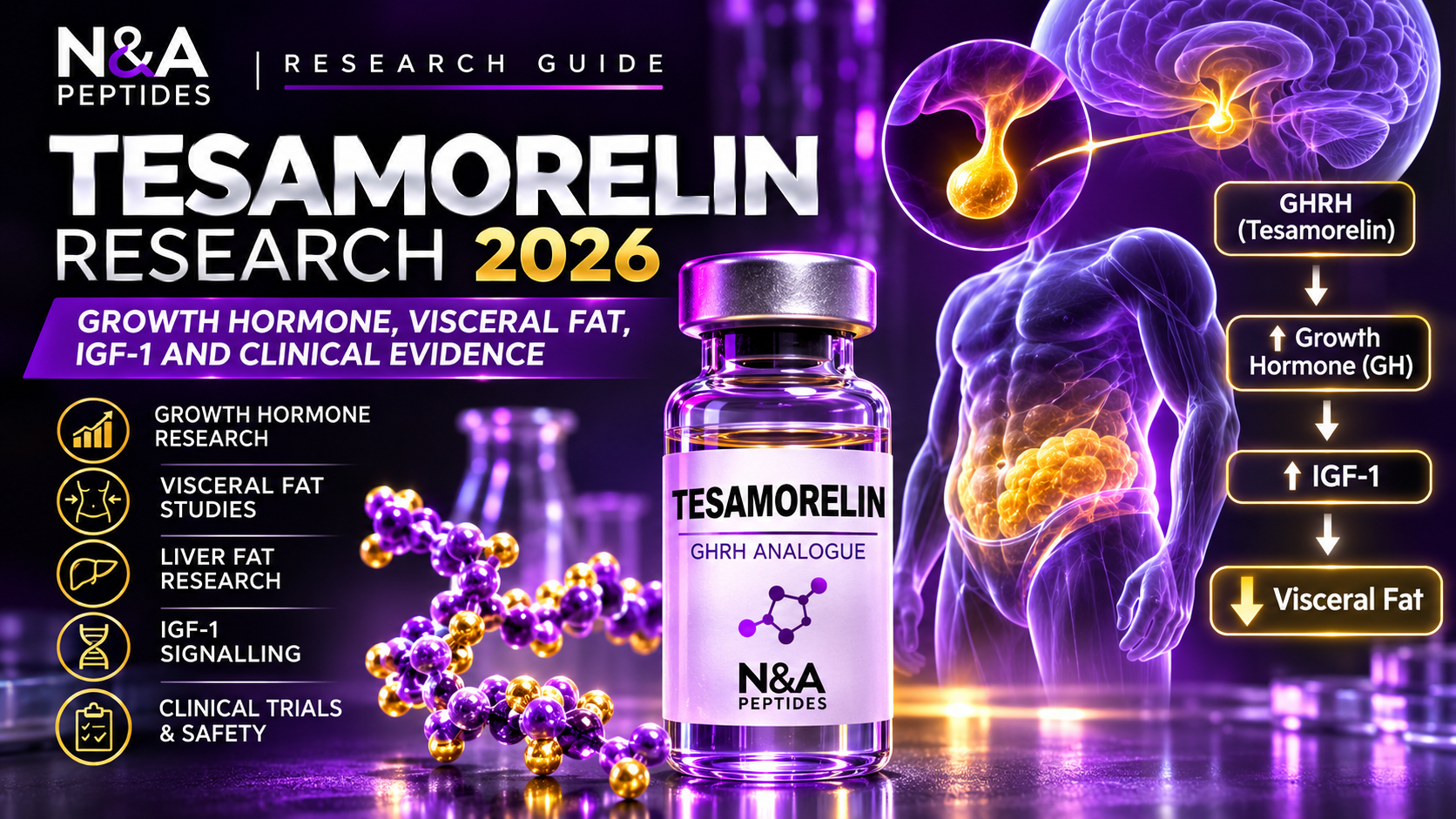
The primary mechanism investigated in tesamorelin research involves the hypothalamic-pituitary-growth hormone axis.
Step 1: Growth Hormone-Releasing Hormone Receptor Activation
Tesamorelin interacts with GHRH receptors on specialised cells within the anterior pituitary gland.
These cells, known as somatotrophs, are responsible for synthesising and releasing growth hormone.
Receptor activation initiates intracellular signalling pathways that stimulate growth hormone secretion.
Step 2: Increased Growth Hormone Signalling
Growth hormone participates in several physiological processes, including:
- Regulation of lipid metabolism.
- Influencing protein synthesis.
- Supporting normal tissue growth and maintenance.
- Regulating metabolic responses.
- Stimulating IGF-1 production.
The relationship between growth hormone and metabolism is complex. Increased signalling can influence fat mobilisation, but it may also affect insulin sensitivity and glucose regulation.
Step 3: IGF-1 Production
Growth hormone stimulates the production of insulin-like growth factor 1, particularly in the liver.
IGF-1 participates in cell growth, tissue maintenance and several metabolic pathways.
Clinical trials have demonstrated that tesamorelin can increase circulating IGF-1 concentrations.
Although this is an expected pharmacological effect, persistently elevated IGF-1 introduces important safety considerations, particularly because the long-term consequences of sustained elevations are not fully established.
Tesamorelin Research and Visceral Fat
One of the most extensively studied applications of tesamorelin involves visceral adipose tissue.
Visceral fat is adipose tissue located deep within the abdominal cavity, surrounding internal organs.
It differs from subcutaneous fat, which is situated beneath the skin.
Visceral adipose tissue is metabolically active and has been associated with insulin resistance, metabolic dysfunction and cardiovascular risk.
Some individuals living with HIV develop abnormal body fat distribution, commonly referred to as HIV-associated lipodystrophy.
This condition formed the basis for major clinical investigations involving tesamorelin.
Clinical Trial: Six-Month Visceral Fat Results
A randomised, placebo-controlled study published in the Journal of Clinical Endocrinology & Metabolism evaluated tesamorelin in adults with HIV and abdominal fat accumulation.
After six months, researchers reported:
- 10.9% reduction in visceral adipose tissue in the tesamorelin group.
- 0.6% reduction in the placebo group.
- Improvement in selected waist and body-composition measurements.
- Increased circulating IGF-1 concentrations.
- No comparable change in limb or abdominal subcutaneous fat.
The study also observed that visceral fat reductions could reach approximately 18% in participants continuing treatment for 12 months.
However, improvements were rapidly lost among participants who switched from tesamorelin to placebo.
This suggests that the observed metabolic response was not necessarily permanent after treatment was discontinued.
Read the published clinical trial on PubMed.
Tesamorelin Clinical Trials: What Do the Results Actually Mean?
The clinical research provides evidence that tesamorelin can reduce visceral adipose tissue in a specific patient population.
However, visceral fat reduction and overall body weight reduction are not interchangeable outcomes.
An individual may experience changes in internal fat distribution without a corresponding large change in total body weight.
For this reason, the US prescribing information explicitly states that tesamorelin is not indicated for general weight-loss management.
It is therefore scientifically inaccurate to assume that results observed in HIV-associated lipodystrophy demonstrate comparable effects in otherwise healthy individuals or people seeking cosmetic fat reduction.
Tesamorelin and Liver Fat Research
Researchers have also investigated whether changes in growth hormone signalling influence fat accumulation within the liver.
Excessive liver fat can contribute to metabolic dysfunction and, in some cases, progressive liver disease.
A 2019 randomised, double-blind, multicentre clinical trial examined tesamorelin in adults living with HIV and non-alcoholic fatty liver disease.
The study investigated changes in hepatic fat fraction, a measurement of the proportion of liver tissue composed of fat.
Key Findings From the 2019 Trial
The trial enrolled 61 participants, with 60 allocated to tesamorelin or placebo groups.
At 12 months, investigators reported:
- A 37% relative reduction in hepatic fat fraction from baseline attributable to treatment compared with placebo.
- An absolute between-group treatment effect of approximately 4.1 percentage points in hepatic fat fraction.
- 35% of participants receiving tesamorelin achieved a hepatic fat fraction below 5%.
- Only 4% of the placebo group achieved the same threshold.
These findings were statistically significant and provided evidence supporting further investigation of growth hormone-releasing hormone analogues in metabolic liver disease.
However, the trial was relatively small and conducted in a specific HIV-positive population.
Further evidence is needed to establish long-term clinical outcomes, including whether improvements in liver fat translate into fewer serious liver-related complications.
Read the Lancet HIV clinical study.
Tesamorelin and IGF-1 Research
Insulin-like growth factor 1 is an important biomarker in studies examining growth hormone activity.
Because tesamorelin stimulates endogenous growth hormone secretion, researchers commonly measure IGF-1 to evaluate the biological response.
IGF-1 is involved in:
- Cellular growth and signalling.
- Normal tissue maintenance.
- Protein metabolism.
- Interactions between growth hormone and metabolic pathways.
However, greater IGF-1 activity is not automatically beneficial.
Abnormally elevated IGF-1 may be associated with unwanted biological effects, and the long-term safety implications of treatment-induced elevations require careful consideration.
The prescribing information for approved US tesamorelin formulations includes warnings regarding elevated IGF-1 and recommends monitoring in clinical practice.
These safety requirements underline the distinction between controlled clinical treatment and unsupervised use of research peptides.
Does Tesamorelin Increase Muscle Growth?
Tesamorelin is sometimes discussed in connection with muscle growth, athletic performance and body composition.
These claims are frequently based on the relationship between growth hormone and protein metabolism.
However, a biological mechanism should not be mistaken for demonstrated clinical effectiveness.
Evidence that tesamorelin increases growth hormone or IGF-1 does not establish that it produces meaningful increases in muscle strength, athletic performance or lean muscle mass in healthy adults.
The major clinical trials were designed primarily to investigate excess visceral fat in people living with HIV.
They were not designed to establish tesamorelin as a bodybuilding treatment.
Further controlled research would be required to evaluate any proposed application outside its established medical indication.
Tesamorelin and Insulin Sensitivity
Growth hormone plays a complex role in carbohydrate metabolism.
Increased growth hormone signalling can influence glucose production, insulin sensitivity and nutrient utilisation.
Some tesamorelin trials reported no statistically significant differences in certain glucose measurements after several months of treatment.
However, other findings identified short-term changes in fasting glucose, and approved product information warns of glucose intolerance and diabetes risk.
These findings illustrate why individual clinical trial results must be evaluated alongside the broader safety evidence.
It would be misleading to describe tesamorelin as metabolically risk-free or universally beneficial for glucose regulation.
Tesamorelin Safety and Potential Adverse Effects
Tesamorelin has been studied in controlled clinical settings, where participants receive medical supervision and appropriate monitoring.
Reported and recognised safety concerns include:
- Elevated IGF-1 concentrations.
- Fluid retention and swelling.
- Joint discomfort and muscle pain.
- Carpal tunnel syndrome.
- Glucose intolerance and diabetes risk.
- Injection-site reactions.
- Hypersensitivity reactions.
There are also important contraindications and precautions involving active malignancy, pregnancy and certain disorders affecting the hypothalamic-pituitary axis.
Long-term cardiovascular safety has not been established.
Researchers must distinguish between the safety profile of licensed pharmaceutical formulations used under medical supervision and the unknown risks of experimental preparations.
Review the official EGRIFTA WR prescribing information.
Tesamorelin Regulatory Status in the United Kingdom
Regulatory status is an important consideration when interpreting tesamorelin research.
Tesamorelin was first approved by the United States Food and Drug Administration in 2010 for reducing excess abdominal fat in adults with HIV-associated lipodystrophy.
That authorisation applies to specific prescription medicinal products and does not extend to general weight management.
Tesamorelin does not currently hold a UK marketing authorisation.
An application for European marketing authorisation for Egrifta was withdrawn in June 2012.
The European Medicines Agency published an official explanation of the withdrawal and the concerns raised during its regulatory assessment.
Read the European Medicines Agency assessment.
It is important to understand that an approved US pharmaceutical formulation is not equivalent to an independently manufactured laboratory research peptide.
Research materials should not be assumed to meet the manufacturing, sterility, safety or clinical requirements applied to licensed medicines.
Research Peptide Purity and Analytical Testing
Reliable experimental results depend on the identity, purity and stability of the material being studied.
For peptide researchers, independent analytical testing is an important component of quality assessment.
High-Performance Liquid Chromatography
High-performance liquid chromatography, commonly abbreviated to HPLC, is widely used to investigate peptide purity.
The technique separates components of a sample according to their interactions with a chromatographic system.
Researchers can use the resulting chromatogram to investigate impurities and evaluate the relative abundance of the principal peptide component.
However, HPLC purity alone does not establish molecular identity, sterility or biological activity.
Mass Spectrometry
Mass spectrometry provides information about molecular mass and can support confirmation of peptide identity.
When appropriately validated, techniques such as liquid chromatography-mass spectrometry can help researchers investigate the composition of peptide samples.
Combining suitable analytical techniques can provide more comprehensive information than reliance on a single purity measurement.
Why Research Documentation Matters
Research documentation may include peptide identity, batch information, analytical methods and reported purity.
Even when a certificate of analysis is available, the scope and limitations of the tests must be understood.
A certificate showing chemical purity does not establish pharmaceutical-grade manufacturing or suitability for human administration.
Explore related educational articles in the N&A Peptides Research Guides collection.
Tesamorelin Compared With Other Peptide Research Areas
Peptide research encompasses several different biological pathways.
Tesamorelin belongs to the growth hormone-releasing hormone analogue class, whereas compounds such as retatrutide are being investigated for their activity at metabolic hormone receptors.
These mechanisms are substantially different.
Retatrutide is being studied as a triple agonist of the GLP-1, GIP and glucagon receptors, while tesamorelin acts primarily through growth hormone-releasing hormone receptor signalling.
Researchers should therefore avoid assuming that compounds investigated for different metabolic outcomes are interchangeable.
For more information about peptide mechanisms and clinical evidence, explore the other articles in the Research Guides category.
What Are the Main Limitations of Tesamorelin Research?
Although tesamorelin has a stronger clinical evidence base than many investigational peptides, several important limitations remain.
- Population specificity: The strongest results relate to adults with HIV-associated lipodystrophy.
- Long-term outcomes: Some important cardiovascular and metabolic outcomes remain uncertain.
- Treatment persistence: Visceral fat improvements may diminish after treatment is stopped.
- Generalisability: Trial findings cannot automatically be applied to healthy adults.
- Formulation differences: Pharmaceutical preparations must not be equated with research-grade materials.
- Safety monitoring: Growth hormone, IGF-1 and glucose-related effects require clinical consideration.
Future investigations may help determine whether tesamorelin or related compounds have additional clinically useful applications.
Any such applications require adequate clinical evidence and appropriate regulatory assessment.
Frequently Asked Questions About Tesamorelin Research
What is tesamorelin used for in clinical medicine?
In the United States, specific prescription formulations of tesamorelin are approved to reduce excess abdominal fat in adults with HIV-associated lipodystrophy. It is not approved for general weight-loss management.
Does tesamorelin increase growth hormone?
Yes. Tesamorelin acts as a growth hormone-releasing hormone analogue and stimulates the release of endogenous growth hormone from the anterior pituitary gland.
What is the difference between visceral fat and subcutaneous fat?
Visceral fat surrounds internal abdominal organs, whereas subcutaneous fat is located beneath the skin. These tissues differ in location, biological behaviour and metabolic associations.
Can tesamorelin reduce liver fat?
A controlled clinical trial in people living with HIV and fatty liver disease reported a significant reduction in hepatic fat fraction. The findings are promising for this specific population but do not establish an approved liver-fat treatment.
Does tesamorelin increase IGF-1?
Clinical trials demonstrate that tesamorelin increases circulating IGF-1. The long-term implications of sustained IGF-1 elevation remain an important safety consideration.
Is tesamorelin approved in the UK?
No UK marketing authorisation has been identified for tesamorelin as of October 2026. The US approval does not constitute UK approval.
Is tesamorelin a general fat-loss peptide?
No. Evidence for reducing visceral abdominal fat in HIV-associated lipodystrophy should not be interpreted as proof of general weight-loss effectiveness.
Can tesamorelin be used for bodybuilding or anti-ageing?
There is insufficient robust clinical evidence to establish tesamorelin as a safe and effective bodybuilding, muscle-growth or anti-ageing treatment in healthy individuals.
Conclusion: What Does the Scientific Evidence Tell Us?
Tesamorelin research provides an important example of how peptide science can progress from molecular investigation to controlled human clinical trials.
Its ability to stimulate growth hormone secretion and influence IGF-1 signalling has been demonstrated in clinical research.
Randomised studies have also shown measurable reductions in visceral adipose tissue in adults with HIV-associated lipodystrophy.
Additional research has reported improvements in liver fat measurements among selected participants.
Nevertheless, these outcomes must be understood within the context of the clinical populations studied.
Tesamorelin is not an established general weight-loss, bodybuilding or anti-ageing treatment, and its long-term safety requires continued investigation.
For more scientific articles covering peptide biology, analytical testing and clinical evidence, visit N&A Peptides or browse the Research Guides library.
Scientific References
- Falutz J, et al. Effects of tesamorelin, a growth hormone-releasing factor, in HIV-infected patients with abdominal fat accumulation: a randomized placebo-controlled trial with a safety extension. Journal of Clinical Endocrinology & Metabolism. 2010. PubMed.
- Stanley TL, et al. Effect of tesamorelin on visceral fat and liver fat in HIV-infected patients with abdominal fat accumulation: a randomized clinical trial. JAMA. 2014. PubMed.
- Stanley TL, et al. Effects of tesamorelin on non-alcoholic fatty liver disease in HIV: a randomised, double-blind, multicentre trial. Lancet HIV. 2019. PubMed.
- US National Library of Medicine. EGRIFTA WR prescribing information, updated 2026. Official prescribing information.
- European Medicines Agency. Egrifta (tesamorelin): Withdrawn marketing authorisation application. 2012. EMA regulatory information.
Scientific disclaimer: This article is intended for educational and scientific research purposes only. It is not medical advice and does not recommend tesamorelin for personal use. Clinical findings involving approved pharmaceutical formulations must not be extrapolated to research-grade products. Laboratory research materials are not intended for human consumption or administration.