Blog
HPLC vs LC-MS Peptide Testing: Methods Explained

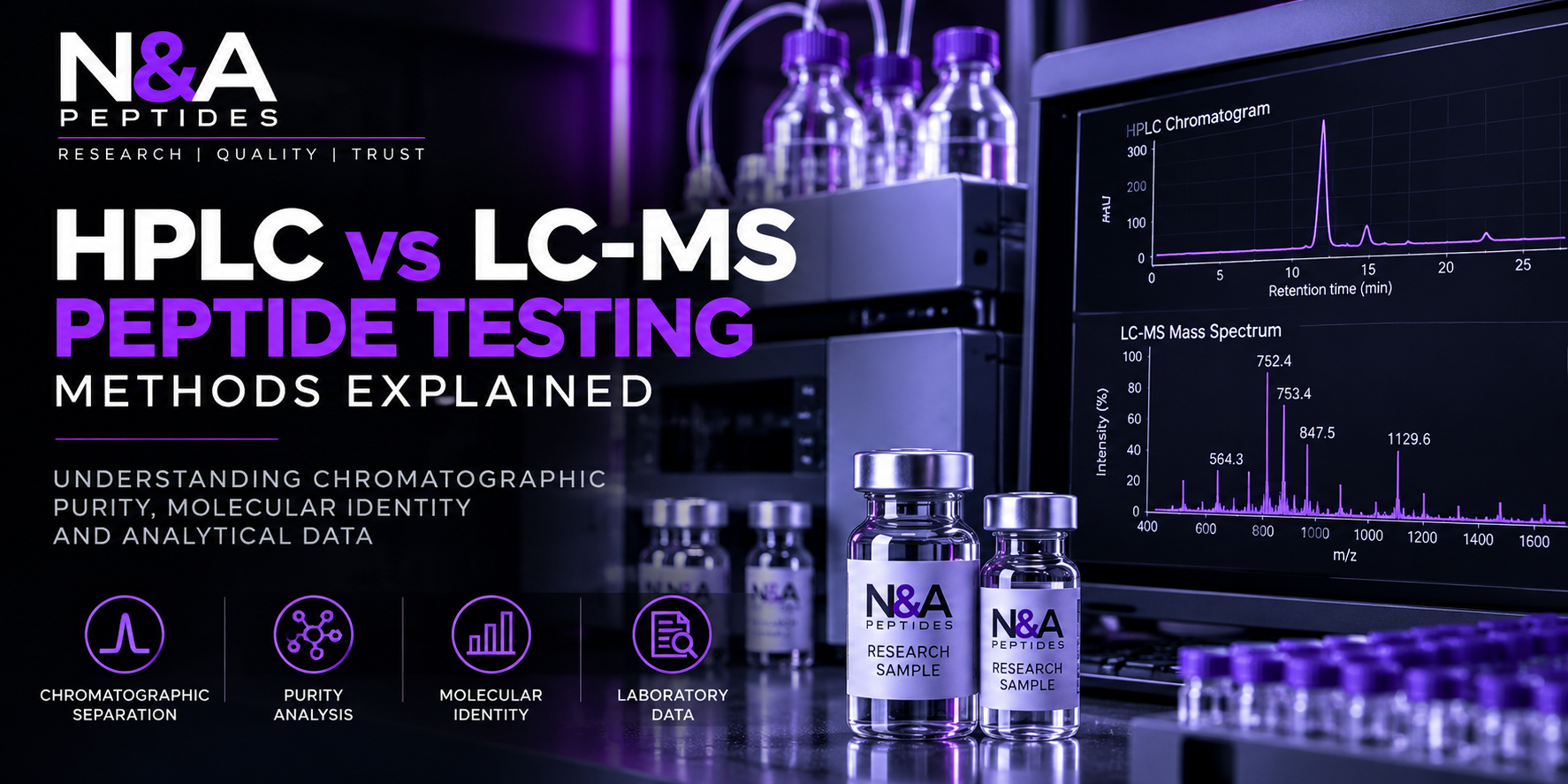
HPLC vs LC-MS peptide testing is an important subject in modern analytical chemistry. Both techniques are used in the analysis of research peptides, but they provide different kinds of information about a laboratory sample.
High-Performance Liquid Chromatography (HPLC) is commonly used to separate sample components and evaluate chromatographic purity. Liquid Chromatography–Mass Spectrometry (LC-MS) combines chromatographic separation with mass spectrometric detection, providing information about the mass-to-charge ratios of detected ions.
Understanding the distinction helps researchers interpret analytical data, compare laboratory methods and assess the information presented in a Certificate of Analysis (COA).
What Is HPLC Peptide Testing?
High-Performance Liquid Chromatography is an analytical separation technique widely used in chemical and pharmaceutical laboratories.
HPLC works by passing a liquid sample through a column containing a stationary phase. Different components interact with the stationary and mobile phases to different extents, producing different retention times.
In peptide analysis, reversed-phase HPLC is commonly used. This technique separates compounds largely according to their hydrophobic interactions with the column material.
As separated compounds pass through a suitable detector, signals are recorded to produce a chromatogram.
What Does an HPLC Chromatogram Show?
A chromatogram typically displays detector response against retention time. Peaks represent substances that produce a response under the selected analytical conditions.
Researchers can examine:
- Retention time: When a detectable component passes through the detector.
- Peak area: An integrated detector response that may be used in quantitative calculations.
- Peak shape: Information about chromatographic behaviour and separation performance.
- Resolution: The degree of separation between neighbouring peaks.
- Baseline: The background detector signal against which peaks are measured.
For some methods, chromatographic area normalisation is used to report a relative purity percentage. However, this figure depends on the detector, integration settings, method conditions and the response of individual components.
A chromatographic purity percentage should not automatically be interpreted as the exact mass fraction of the target peptide in the sample.
Our related article, What Does 99% Peptide Purity Mean?, explores this distinction in greater detail.
What Is LC-MS Peptide Testing?
Liquid Chromatography–Mass Spectrometry combines a liquid chromatography system with a mass spectrometer.
The chromatography stage separates compounds within a sample. The mass spectrometer then detects ions according to their mass-to-charge ratio, commonly written as m/z.
Electrospray ionisation is frequently used for peptide LC-MS because peptides can form multiply charged ions during analysis.
Why Are Multiple Charge States Important?
A peptide may produce several peaks corresponding to different charge states in a mass spectrum.
For example, ions carrying two, three or four positive charges may appear at different m/z values even though they originate from the same molecular species.
Analytical software can use a suitable series of charge-state peaks to estimate the neutral molecular mass of a peptide.
This information can help determine whether the measured mass is consistent with the expected molecular composition.
However, a mass match alone does not establish every aspect of molecular identity. Isomers and some sequence-related structures can share the same nominal or exact mass.
HPLC vs LC-MS Peptide Testing: Key Differences
| Feature | HPLC | LC-MS |
|---|---|---|
| Primary principle | Chromatographic separation | Separation followed by mass spectrometric detection |
| Typical output | Chromatogram | Chromatogram and mass spectral data |
| Purity assessment | Possible with a suitable validated method | Possible with an appropriately developed quantitative method |
| Molecular mass information | Not provided by ordinary UV detection alone | Provided through observed ion mass-to-charge ratios |
| Impurity investigation | Can separate and measure detectable impurities | Can assist with detecting and characterising impurities |
| Main limitation | Peaks do not necessarily identify individual compounds | Ionisation response and matrix effects may complicate quantification |
The two techniques should not be treated as direct substitutes. They can be complementary analytical approaches, depending on the question being investigated.
Can HPLC Confirm Peptide Identity?
Chromatographic retention time can provide supporting evidence about a compound when compared under controlled conditions with a suitable reference material.
However, retention time alone is generally insufficient for unequivocal identification. Different compounds can sometimes elute at similar times, and changes in method conditions can alter retention behaviour.
Additional evidence may come from accurate mass measurements, fragmentation spectra, suitable reference standards or other orthogonal analytical methods.
The FDA’s ICH Q6A guidance discusses the limitations of relying solely on chromatographic retention time for identification and describes combinations of analytical techniques.
Read the FDA guidance on identification and analytical specifications for the relevant pharmaceutical regulatory context.
Can LC-MS Measure Peptide Purity?
LC-MS can contribute to purity and impurity assessments, but interpreting signal intensity requires care.
Different molecular species may ionise with different efficiencies. Consequently, a compound producing a relatively small mass spectrometric signal may not necessarily represent a correspondingly small amount by mass.
Ion suppression, detector response, sample preparation and calibration can also influence quantitative results.
Reliable quantification therefore depends on an appropriate analytical method, reference materials where necessary, and evidence that the method performs adequately for its intended purpose.
LC-MS data are particularly useful for supporting molecular-mass assignments and investigating selected impurities. They should not automatically be interpreted as a complete quantitative measurement of all substances present.
Understanding Method Validation in Peptide Analysis
An analytical method must be suitable for the scientific question it is intended to answer.
The International Council for Harmonisation publishes ICH Q2(R2), which explains principles used in analytical procedure validation for its specified regulatory applications.
Important performance characteristics include:
- Specificity or selectivity: Whether the method can distinguish the analyte from relevant interfering substances.
- Accuracy: How closely a quantitative result agrees with an accepted reference value.
- Precision: The consistency of repeated measurements.
- Working range: The interval over which appropriate analytical performance has been demonstrated.
- Detection limit: The lowest amount detectable under defined conditions.
- Quantitation limit: The lowest amount that can be quantified with suitable performance.
Not every characteristic applies to every method. The required validation work depends on whether the procedure is intended for identification, impurity detection, quantitative impurity analysis or assay measurement.
For more information, consult the European Medicines Agency’s ICH Q2(R2) analytical validation guidance.
These are pharmaceutical regulatory principles; their applicability to a particular non-clinical laboratory method should be assessed rather than assumed.
How Are HPLC and LC-MS Results Presented on a Certificate of Analysis?
Laboratory reports may summarise chromatographic purity, analytical methods, expected molecular mass and observed mass spectrometric findings.
A comprehensive analytical package may also include chromatograms, mass spectra, method references and batch identifiers.
Researchers reviewing a report should distinguish between a reported result and the analytical evidence supporting that result.
Information Worth Checking
- The sample name and unique batch or sample identifier.
- The laboratory responsible for the analysis.
- The date the sample was tested.
- The analytical technique and detection method used.
- The reported purity value and how it was calculated.
- Whether expected and observed molecular masses are shown.
- Whether supporting chromatograms or spectra are available.
- Whether method suitability or validation information is provided.
- Whether the conclusions are appropriately limited to the tests performed.
A report providing HPLC and MS results is not necessarily evidence of sterility, endotoxin content, peptide content, potency or suitability for administration. These require their own appropriate assessments.
For a detailed explanation of the information found on analytical reports, visit our guide to reading a Peptide Certificate of Analysis.
Common Misunderstandings About HPLC and LC-MS
Does a Single HPLC Peak Prove a Sample Is Pure?
No. Co-eluting substances may appear together, and some impurities may not produce a detectable response with the selected detector.
Does a Correct Molecular Mass Prove the Exact Peptide Sequence?
Not necessarily. Mass measurements provide important molecular information, but additional sequence-specific analytical evidence may be required.
Is LC-MS Always Better Than HPLC?
No. The appropriate technique depends on the analytical objective. HPLC with suitable detection can provide robust separation and quantitative information, while LC-MS supplies additional mass spectrometric evidence.
Does 99% HPLC Purity Mean 99% of the Labelled Weight Is Peptide?
Not automatically. Chromatographic area percentage and absolute peptide mass content are different measurements. Water, counterions, residual solvents and detector response may affect how results should be interpreted.
Can Two Laboratories Produce Different Results?
Yes. Differences in sample preparation, instrumentation, chromatographic conditions, integration procedures, calibration and analytical uncertainty can affect reported findings.
Results should be compared with reference to the methods used rather than treating every reported percentage as directly interchangeable.
Why Complementary Analytical Methods Matter
No single analytical method necessarily answers every question about the identity, purity and composition of a research sample.
Chromatographic separation, mass spectrometry and other appropriate tests can provide complementary evidence.
The most informative analytical approach is one that uses techniques suited to the sample, defines what is being measured and reports the limitations of the conclusions.
Researchers can explore our broader collection of articles in the N&A Peptides Research Guides.
Scientific References
- European Medicines Agency: ICH Q2(R2), Validation of Analytical Procedures.
- US Food and Drug Administration: ICH Q6A, Specifications and Analytical Test Procedures.
- US Food and Drug Administration: Analytical Procedures and Methods Validation for Drugs and Biologics.
Conclusion: Understanding HPLC vs LC-MS Peptide Testing
HPLC and LC-MS are complementary analytical techniques that can provide valuable information about research peptides.
HPLC is used to separate sample components and, with an appropriate method, investigate purity. LC-MS combines separation with mass spectrometric detection, helping laboratories assess molecular mass and characterise selected compounds or impurities.
Neither technique should be interpreted in isolation from the analytical method, supporting evidence and intended purpose of the test.
By understanding these differences, researchers can interpret chromatograms, mass spectra and Certificates of Analysis more accurately.
Research information only: This article discusses laboratory analytical techniques. It does not establish the safety, efficacy, sterility or suitability of any peptide for human or veterinary administration.