Blog
What Are Peptide Impurities? Identification and Laboratory Testing

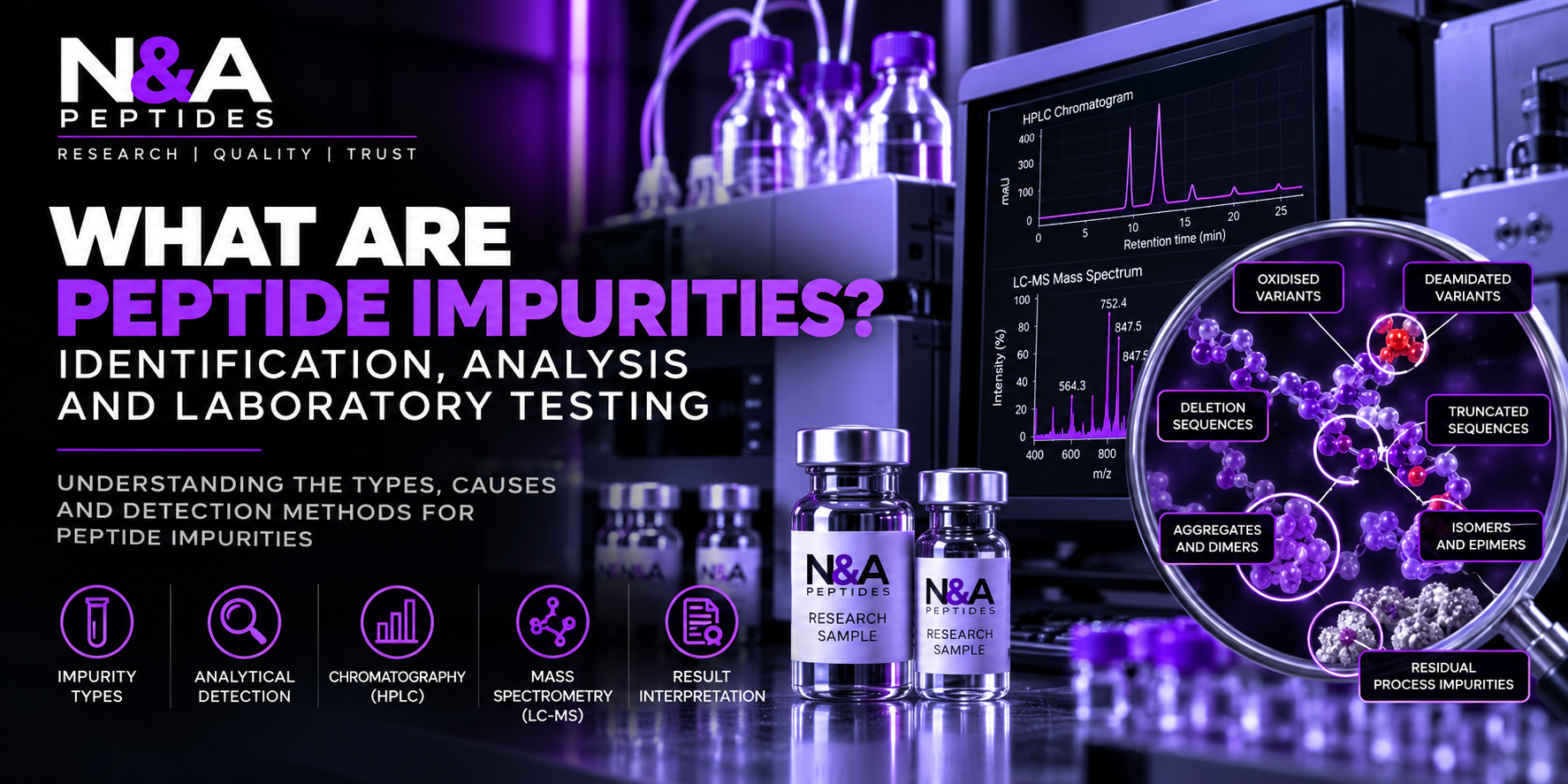
Peptide impurities are substances or molecular variants found alongside a target peptide that differ from the intended molecular structure or composition. They may arise during chemical synthesis, purification, manufacturing, storage or laboratory handling.
Understanding peptide impurities is an important part of analytical chemistry, particularly when interpreting research sample purity, molecular identity and laboratory testing reports.
Modern analytical techniques, including high-performance liquid chromatography (HPLC) and liquid chromatography–mass spectrometry (LC-MS), can help laboratories detect, separate and characterise peptide-related impurities.
This research guide explains seven important categories of peptide impurities, how they may arise and what analytical testing can establish.
What Are Peptide Impurities?
A peptide is a molecule composed of amino acids joined by peptide bonds. Its chemical identity depends on the amino acid sequence and any intended structural modifications.
During synthesis or subsequent handling, additional molecular species may appear. These can include incomplete sequences, chemically modified peptides, residual synthesis materials and degradation products.
Not every impurity has the same chemical properties, and not every impurity can be detected using a single analytical technique.
Consequently, a comprehensive evaluation may require several complementary analytical methods.
7 Types of Peptide Impurities
1. Deletion Sequence Impurities
Deletion sequences occur when one or more intended amino acids are absent from the peptide chain.
For example, a peptide designed to contain a specific sequence may instead contain a shorter molecular variant because a coupling reaction was incomplete during synthesis.
The resulting substance can differ in molecular mass, chromatographic retention and chemical behaviour.
Mass spectrometry may help identify sequence-related mass differences, although additional structural evidence can be necessary.
2. Truncated Peptide Impurities
Truncated peptides contain shorter sequences than the intended molecule.
They may originate from incomplete chain assembly or chemical cleavage, depending on the manufacturing or degradation process.
A truncated peptide is not necessarily identical to a deletion impurity: deletion describes missing residues within a sequence, while truncation generally refers to a shortened chain.
Analytical characterisation may involve HPLC, LC-MS and suitable sequence-specific methods.
3. Oxidised Peptide Impurities
Oxidation involves a chemical modification caused by reactions involving oxygen or other oxidising species.
Certain amino acid residues, including methionine and cysteine, can be susceptible to oxidative modification, depending on the peptide and conditions.
Oxidation can affect molecular composition and may influence stability or structural characteristics.
Suitable mass spectrometric techniques can help investigate changes in molecular mass, while chromatographic methods may separate oxidised variants.
4. Deamidated Peptide Impurities
Deamidation is a chemical process that can affect susceptible amino acid residues, particularly asparagine and glutamine.
The reaction can change the molecular structure and may generate different chemical variants.
Deamidation rates depend on several factors, including sequence context, temperature, pH and environmental conditions.
Analytical identification may require a combination of chromatography and high-resolution mass spectrometry.
5. Isomerised or Epimerised Peptides
Some peptide impurities have the same elemental composition as the intended peptide but differ in structural arrangement or stereochemistry.
Epimerisation involves a change in configuration at a stereogenic centre, while isomerisation is a broader term covering structural rearrangements.
Because some isomeric species share the same molecular mass, mass measurement alone may not distinguish them.
Carefully developed chromatographic or specialised structural analysis may therefore be required.
6. Peptide Aggregates and Dimers
Peptide molecules can sometimes associate to form larger assemblies, including dimers or higher-order aggregates.
Depending on the system, these associations may be reversible or irreversible and may arise through non-covalent interactions or covalent bonding.
Suitable analytical approaches can include size-exclusion chromatography, light scattering and mass spectrometry, depending on the properties of the material.
Aggregation behaviour should not be inferred solely from an ordinary reversed-phase HPLC purity percentage.
7. Residual Process-Related Impurities
Not all impurities are altered versions of the peptide itself.
Chemical synthesis and purification may introduce or leave behind residual solvents, reagents, salts or other process-related substances.
These materials may require analytical methods different from those used to assess peptide sequence-related impurities.
For example, gas chromatography can be useful for certain volatile residual solvents, while other chemical or elemental analytical techniques may be needed for different impurity classes.
Peptide Impurities Comparison Table
| Impurity type | Possible origin | Potential analytical approach |
|---|---|---|
| Deletion sequences | Incomplete synthesis | LC-MS and chromatography |
| Truncated peptides | Incomplete assembly or cleavage | HPLC and LC-MS |
| Oxidised variants | Chemical oxidation | HPLC and mass spectrometry |
| Deamidated variants | Chemical degradation | LC-MS and suitable separation methods |
| Isomers or epimers | Synthesis or structural rearrangement | Specialised chromatography and structural analysis |
| Aggregates | Molecular association | Size-exclusion chromatography and other appropriate methods |
| Residual process materials | Manufacturing or purification | Method dependent, including GC or other chemical tests |
These techniques are examples rather than universal testing requirements. The appropriate method depends on the chemical characteristics of the analyte and the intended analytical purpose.
How Are Peptide Impurities Detected?
High-Performance Liquid Chromatography
HPLC separates compounds according to their interactions with a chromatographic system.
When peptide-related impurities are sufficiently resolved and detectable, they may appear as additional peaks in a chromatogram.
However, compounds may co-elute, and some impurities may respond differently to the selected detector.
Therefore, the absence of an obvious additional peak does not prove that every possible impurity is absent.
Liquid Chromatography–Mass Spectrometry
LC-MS combines chromatographic separation with mass spectrometric detection.
The technique provides information about observed mass-to-charge ratios and can support molecular identification or impurity characterisation.
More specialised tandem mass spectrometry techniques may provide additional structural evidence through fragmentation patterns.
For a detailed comparison, read our HPLC vs LC-MS Peptide Testing guide.
Other Analytical Techniques
Depending on the impurity being investigated, laboratories may use complementary approaches such as gas chromatography, amino acid analysis, size-exclusion chromatography, nuclear magnetic resonance spectroscopy or other chemical and structural methods.
The value of combining techniques is that different methods provide different types of evidence.
Can a Peptide Have 99% Purity and Still Contain Impurities?
Yes. A result reported as 99% chromatographic purity does not mean that every possible impurity has been identified or quantified.
For example, a chromatographic area percentage may reflect the relative signal of detected components under a particular method.
It may not account adequately for residual water, counterions, solvents, poorly detected materials or compounds that co-elute with the principal peak.
The interpretation depends on the analytical procedure and the way the percentage was calculated.
Our guide, What Does 99% Peptide Purity Mean?, explains why chromatographic purity and absolute sample composition are not interchangeable.
How Do Storage Conditions Influence Peptide Degradation?
Some peptide impurities arise after synthesis through chemical or physical changes during storage.
Potential contributing factors include temperature, moisture, pH, light exposure, oxygen and the intrinsic chemical properties of the peptide.
Different peptides exhibit different stability profiles, so universal storage conditions should not be assumed.
Lyophilisation can improve stability for certain formulations by reducing available water, but freeze-drying does not guarantee chemical stability or prevent every degradation pathway.
Stability assessments should use appropriate analytical testing and conditions relevant to the specific material.
What Is Impurity Profiling?
Impurity profiling is the analytical investigation of substances or molecular variants present alongside a target compound.
Depending on the context, profiling may involve detecting individual impurities, estimating their abundance, characterising their chemical identity and studying changes over time.
The US Food and Drug Administration has described regulatory research involving LC-MS/MS methods for characterising peptide impurities in pharmaceutical products.
In one research programme involving calcitonin products, investigators identified numerous peptide-related impurities using chromatographic and mass spectrometric techniques.
See the FDA research report on complex mixtures and peptide impurity characterisation.
This pharmaceutical research provides useful examples of analytical capabilities but does not establish impurity specifications for every research peptide.
Understanding Peptide Impurities on a Certificate of Analysis
A Certificate of Analysis may provide the results of selected analytical procedures performed on a defined sample or batch.
When reviewing a report, researchers should look for:
- The correct sample and batch identification.
- The laboratory responsible for testing.
- The analytical technique used.
- The reported purity result and its calculation basis.
- Information about observed impurity peaks where available.
- Supporting chromatograms or spectra.
- The test date and report reference.
- Any stated methodological limitations.
Not every COA includes a complete impurity characterisation. A summary purity value cannot independently establish the presence or absence of every possible impurity.
Our Peptide Certificate of Analysis guide explains how to interpret analytical reports and laboratory testing information.
Regulatory Guidance on Synthetic Peptide Impurities
Impurity assessment in pharmaceutical development is subject to regulatory requirements that depend on the type of product and applicable jurisdiction.
The European Medicines Agency has published guidance specifically concerning the development and manufacture of synthetic peptides.
Importantly, the guideline explains that synthetic peptides are outside the scope of ICH Q3A, meaning general Q3A impurity thresholds must not automatically be applied to synthetic peptide substances.
For details, consult the EMA Guideline on the Development and Manufacture of Synthetic Peptides.
Requirements for authorised medicines should not be represented as universal specifications or certification standards for non-clinical laboratory research materials.
Frequently Asked Questions About Peptide Impurities
Are All Peptide Impurities Detectable by HPLC?
No. Detection depends on the analytical method, detector response, chromatographic separation and characteristics of the impurity.
Can Mass Spectrometry Identify Every Impurity?
No. Mass spectrometry is powerful, but some compounds may require additional separation or structural analysis. Certain isomers can share the same molecular mass.
Does a High Purity Percentage Prove a Peptide Is Safe?
No. A purity percentage is an analytical result and does not independently establish safety, sterility, biological activity or suitability for human or veterinary administration.
Can Different Laboratories Report Different Purity Results?
Yes. Differences in analytical methods, sample preparation, detection systems, calibration and data processing can influence reported findings.
What Is the Difference Between an Impurity and a Degradation Product?
An impurity is a broad category of unwanted or unintended substances. A degradation product is a substance formed through chemical or physical change of a material and can therefore be one type of impurity.
Scientific References and Further Reading
- European Medicines Agency: Guideline on the Development and Manufacture of Synthetic Peptides.
- FDA: Regulatory Science Research on Complex Mixtures and Peptide Impurities.
- EMA: ICH Q2(R2), Validation of Analytical Procedures.
Conclusion: Why Peptide Impurity Analysis Matters
Peptide impurities may arise from incomplete synthesis, molecular modification, degradation, aggregation or residual manufacturing materials.
Understanding these different categories allows laboratories to select suitable testing approaches and interpret analytical findings more accurately.
HPLC, LC-MS and other complementary methods provide valuable information, but every analytical conclusion must be interpreted in the context of the method used and the sample investigated.
A well-documented laboratory analysis should clearly communicate what was measured, the methods employed and the limitations of the results.
Explore more educational articles in the N&A Peptides Research Guides.
Research information only: This material is intended for educational discussion of laboratory analytical science. It does not establish the safety, efficacy, sterility or suitability of any peptide for human or veterinary use.