Blog
GHK-Cu Research: Copper Peptide, Skin, Hair and Scientific Evidence (2026)

GHK-Cu Research: Copper Peptide, Skin, Hair and Scientific Evidence (2026)
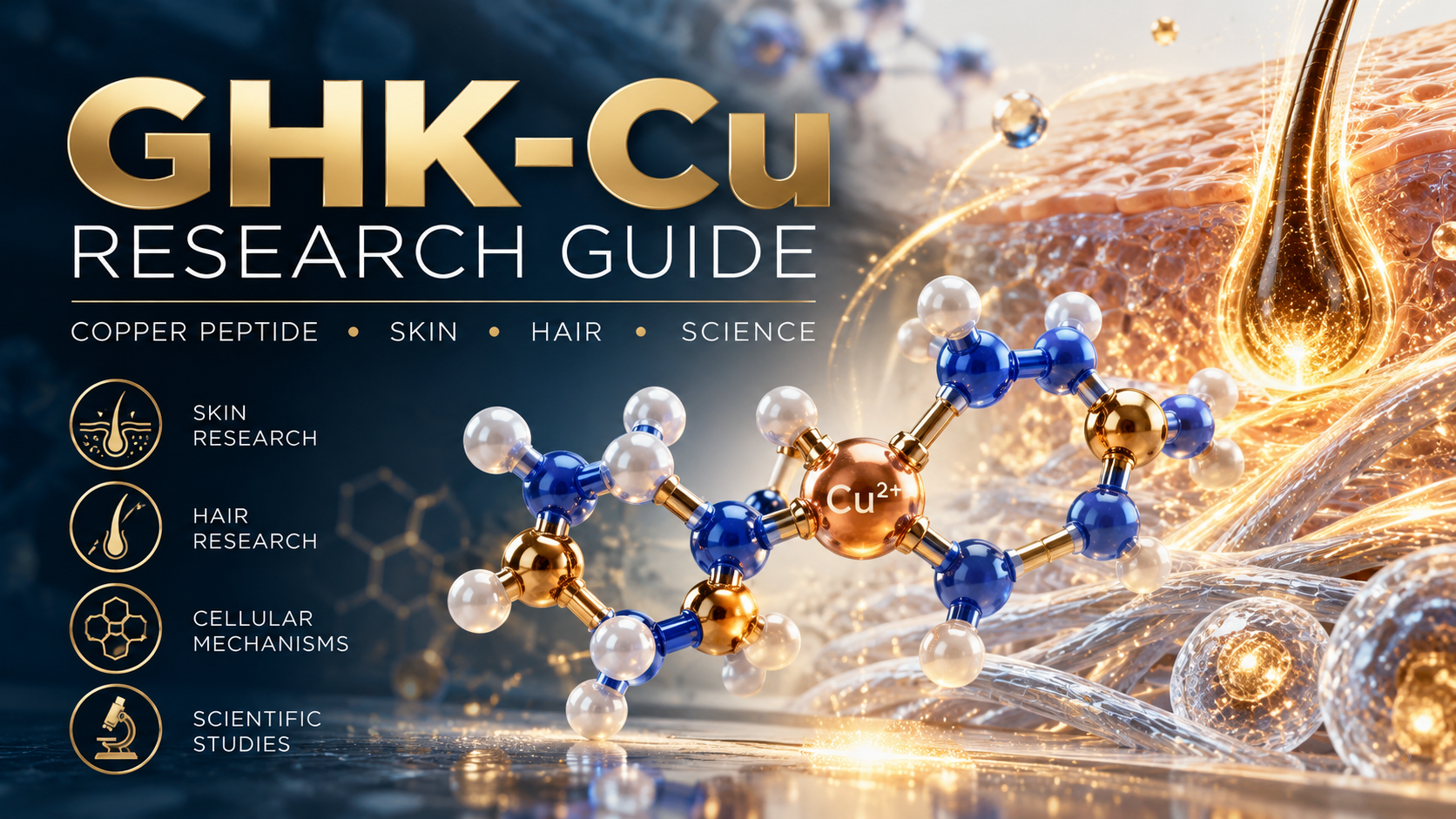
GHK-Cu research explores the biological properties of a copper-binding tripeptide studied in skin biology, extracellular matrix organisation, cellular signalling and experimental tissue repair. GHK-Cu is often discussed in connection with collagen, ageing skin, hair growth and wound models, but many online claims extend considerably beyond the published human evidence.
This research guide from N&A Peptides examines what GHK-Cu is, why copper coordination matters, what laboratory and clinical studies have reported, and where important uncertainties remain. It distinguishes between experiments on cells, studies in animals, small topical cosmetic trials and unsupported claims concerning systemic or injectable use.
What Is GHK-Cu?
GHK stands for glycyl-L-histidyl-L-lysine, a sequence of three amino acids. It is described as a naturally occurring copper-binding peptide. GHK-Cu is the complex formed when this peptide coordinates with copper, generally discussed in the context of copper(II) chemistry. The unbound peptide, often called apo-GHK, and its copper-bound forms should not automatically be treated as chemically or biologically identical.
The copper ion contributes to the chemical properties of the complex. A product described as a “copper peptide” may differ from another in terms of its copper occupancy, free copper content, composition and stability. Those distinctions become especially important when researchers attempt to compare published results.
Research identity: glycyl-L-histidyl-L-lysine–copper complex; common abbreviation: GHK-Cu; category: copper-binding tripeptide. The formula and molecular mass reported for a commercial material can depend on the precise complex, counterions and hydration state. Researchers should consult batch-specific analytical documentation rather than relying on one generic molecular-weight value.
Why Is GHK-Cu Research Important?
The popularity of GHK-Cu research reflects interest in the extracellular matrix, a network of proteins and other molecules that gives tissues structure. Skin contains collagen, elastin, glycosaminoglycans and many signalling molecules. Changes in their production, degradation and arrangement occur during ageing, injury and normal remodelling.
Laboratory investigators have examined whether GHK-Cu influences fibroblast activity, matrix regulation, redox signalling and inflammatory pathways. Several experiments report changes in these processes, giving scientists hypotheses worth investigating. Yet an altered laboratory marker is not equivalent to a noticeable improvement in skin appearance or a medical benefit in humans.
For the wider context of experimental compounds, read the N&A Peptides research peptides UK guide. That introduction explains laboratory applications, documentation and research-only classifications.
GHK-Cu Research and Collagen: What Do Experiments Show?
Collagen is a family of structural proteins, with types I and III especially relevant to many connective tissues. Its presence alone does not determine tissue quality: fibre alignment, cross-linking, degradation and interactions with other matrix components also matter. Skin strength and elasticity arise from the combined behaviour of multiple systems.
Cell-culture studies have investigated GHK-Cu-associated changes in collagen production and expression of molecules involved in matrix turnover. Some findings suggest that copper peptide exposure can influence fibroblast behaviour. However, culture conditions are artificial and the concentrations reaching living human skin after a topical application may differ substantially from those used in vitro.
Scientists also study matrix metalloproteinases, or MMPs, enzymes that participate in remodelling extracellular proteins. A simplified claim that a peptide merely “boosts collagen” misses the importance of controlled synthesis, breakdown and architecture. Effective remodelling is about balance, not simply increasing one measured marker.
A critical 2026 review concluded that preclinical matrix-related findings are biologically interesting but clinical evidence for GHK-Cu remains sparse. Differences between formulations and inadequate chemical characterisation limit direct comparisons between studies.
GHK-Cu and Skin Ageing Studies
Ageing skin is affected by ultraviolet radiation, genetics, environmental exposures and normal biological changes. Common research endpoints include wrinkle depth, elasticity, surface texture, pigmentation and barrier function. Scientists have examined cosmetic formulations containing copper peptides for some of these endpoints.
Small historical studies reported improvements in selected skin appearance measurements. Nevertheless, several are reported only as conference abstracts or contain incomplete descriptions of formulation composition. Such reports can support further investigation, but they do not justify sweeping claims of proven age reversal.
A controlled post-laser skin study provides an important counterexample: among 13 participants who completed follow-up, investigators did not identify an objective advantage for the copper-peptide regimen in the principal measured outcomes, although subjective satisfaction differed. This illustrates why positive experimental mechanisms and attractive marketing explanations require confirmation in clinical trials.
Bottom line: topical GHK-Cu is an active area of cosmetic research, but the size, consistency and durability of effects remain uncertain. Cosmetic outcomes should not be conflated with treatment of medical conditions.
GHK-Cu Research on Wound Healing and Tissue Repair
Wound healing includes overlapping processes: haemostasis, inflammation, cell proliferation, formation of new matrix and later remodelling. Different tissue types and injury models respond differently. Consequently, a result in a rodent wound model cannot establish a treatment benefit for a surgical incision, chronic ulcer or sports injury in humans.
Preclinical GHK-Cu research has reported effects in some models of epithelial repair, angiogenesis and matrix organisation. These findings suggest plausible biological pathways for further investigation. However, protocols differ widely in formulation, concentration, route, comparator and study endpoint.
Controlled human trials are much more useful for assessing whether a compound changes wound closure time, infection risk, scarring, pain or longer-term tissue function. As described in a 2026 systematic evidence-mapping review, an acute-wound clinical study had been registered but had no reported efficacy results at its August 2026 search cutoff.
Trial registration means an investigation is planned or under way. It does not establish that a product works, that it is safe, or that it has received regulatory approval.
GHK-Cu Research and Hair Biology
Hair growth depends on the cycling activity of follicles, hormones, genetics, inflammation and local tissue signalling. Investigators studying hair and eyebrows sometimes evaluate follicular density, hair diameter, growth photographs and participant assessments.
Interest in GHK-Cu comes partly from its associations with extracellular matrix biology and growth-related signalling pathways. Yet these mechanisms do not automatically imply effectiveness for androgenetic alopecia, alopecia areata or other causes of hair loss.
A small 2026 randomised, double-blind split-face study involving 18 healthy participants reported favourable eyebrow hair outcomes after use of a nominal GHK-Cu serum. This is a useful early clinical observation but not definitive proof of effectiveness. The trial was small and the active copper-peptide chemistry was incompletely characterised.
Other small studies involving combinations of copper peptides, microneedling and established hair treatments are difficult to interpret because multiple interventions were used together. Without suitable control groups, researchers cannot identify which component caused a reported difference.
GHK-Cu Research, Copper and Biological Signalling
Copper is an essential trace element involved in several enzyme systems. Copper-dependent processes include aspects of cellular energy metabolism and extracellular matrix cross-linking. Still, free copper can participate in chemical reactions that may be harmful in excess. This is why copper binding, exposure and the chemical form of a substance matter.
A GHK-Cu mixture may contain intact complex, unbound peptide and varying quantities of labile copper. These components can change under different pH conditions or in the presence of other ligands. Laboratory results therefore depend not just on the peptide sequence, but also on sample preparation and surrounding chemical conditions.
Recent authors have highlighted the need to describe the actual molecular species present, rather than reporting only the nominal mass of “GHK-Cu” in a formulation. Research on signalling pathways is strongest when experiments independently compare the peptide, copper alone, the peptide–copper complex and appropriate controls.
Inflammation and Oxidative Stress: What Is Known?
Inflammation and oxidative stress are interconnected but distinct biological concepts. Controlled inflammatory signalling is crucial to normal immunity and tissue maintenance. Reactive oxygen species participate in signalling, while excessive activity can damage molecular structures.
Some GHK-Cu research has examined changes in inflammatory and redox markers in cell and animal models. Reported changes suggest candidate mechanisms, but findings are not uniform across all experiments or model systems.
It would be inaccurate to conclude that GHK-Cu has established anti-inflammatory or antioxidant treatment effects in humans. The clinical importance of molecular changes needs testing through studies that measure outcomes relevant to patients, using well-defined materials and adequate comparison groups.
GHK-Cu Delivery and Skin Penetration
Delivery is a major research challenge for many peptides. The outermost layer of healthy skin, the stratum corneum, restricts movement of numerous hydrophilic molecules. The way a substance behaves on a laboratory membrane does not necessarily predict its penetration through living skin.
Researchers have examined topical formulations and experimental delivery systems to determine how copper peptides interact with the skin barrier. These studies may use cultured skin, excised tissue or other non-clinical systems. They can provide useful information about transport but not definitive evidence of efficacy.
Reviews discuss microneedle technologies as an experimental delivery approach, but this should not be interpreted as instructions to combine peptides with skin-penetrating procedures. Research into delivery efficiency is not evidence of safety, and skin disruption introduces additional clinical risks.
Evidence about topical products also cannot be transferred to oral or injectable administration. Those routes produce fundamentally different exposure patterns, and human safety data for systemic GHK-Cu are insufficient.
What Do Human GHK-Cu Studies Actually Establish?
The human evidence base is far smaller than the preclinical literature. Several cosmetic reports involve small participant groups; some older findings are not available as full peer-reviewed clinical publications. There are also negative or inconclusive controlled results.
| Research area | Type of evidence | Important limitation |
|---|---|---|
| Collagen and matrix regulation | Cell and preclinical experiments | Laboratory markers do not prove clinical benefit |
| Skin appearance | Small topical human studies | Formulations and methods vary; limited replication |
| Post-laser recovery | Small controlled human investigation | No clear objective advantage on main measured outcomes |
| Eyebrow hair outcomes | Small 2026 controlled cosmetic study | Only 18 participants; incomplete active-complex characterisation |
| Injectable or oral applications | Insufficient qualifying human evidence | Safety and effectiveness not established |
The available findings may support further trials, but they should not be described as proof that GHK-Cu regenerates human tissue, reverses ageing or reliably treats hair loss. More independent, adequately powered studies are required.
Is GHK-Cu Safe?
Safety depends on the material, formulation, intended exposure route and conditions of use. Assessments of appropriately formulated cosmetic ingredients are not equivalent to an assessment of unapproved injectable preparations or general systemic exposure.
Potential research questions include irritation, sensitisation, copper exposure, formulation instability, impurities and the consequences of repeated administration. Clinical safety conclusions require rigorous testing and appropriate monitoring.
A reported purity value on its own does not prove sterility, absence of endotoxins, tolerance in humans, regulatory approval or medical efficacy. A label stating “research use only” does not change the need for legal and safety compliance.
How Do Researchers Evaluate GHK-Cu Purity and Identity?
GHK-Cu research has a special analytical complication: laboratories may need to consider both peptide identity and copper coordination chemistry. A single generic assay may not describe every relevant property of a copper-peptide material.
High-performance liquid chromatography (HPLC) can separate components and provide data on relative chromatographic composition under specified conditions. Mass spectrometry can help examine peptide identity or molecular species, but sample preparation and ionisation may alter metal coordination. Additional techniques may be needed to assess copper content, complexation and free copper.
For a practical explanation of common testing methods, see our HPLC vs LC-MS peptide testing guide. Our article on peptide impurities and laboratory testing explains why impurities may matter when interpreting research outcomes.
Research documentation should state exactly what was measured, with suitable identification and batch references. Learn how to assess the results in our Certificate of Analysis (COA) guide.
Why Batch Documentation Matters in GHK-Cu Research
Reproducibility means that other investigators can repeat a study and understand why results agree or differ. This is difficult when the tested substance is ambiguously identified. Batch numbers, analytical methods and suitable chemical specifications help research teams track materials throughout an experiment.
Researchers should ask whether the report describes the material they actually received, whether the methods fit the research objective and whether relevant analytical limitations are disclosed. A batch COA is a description of results obtained from specified tests, not an unrestricted guarantee of every property.
Readers interested in examples of how research material is presented can view the N&A Peptides GHK-Cu 100mg research pen information page. The listing is intended for laboratory research purposes only and should not be read as a claim of human safety or efficacy.
GHK-Cu Research in the UK: Regulatory Context
UK regulatory requirements depend on the nature of the product, its intended purpose, presentation and claims. A cosmetic ingredient used in a compliant cosmetic formulation is not equivalent to an investigational medicinal product. The latter may require medicine-specific permissions, appropriate manufacturing controls and clinical-trial authorisations.
There is no UK marketing authorisation establishing GHK-Cu as an injectable therapy for skin repair, hair growth or systemic rejuvenation. Marketing claims concerning prevention or treatment of disease can change how a product is classified.
Those conducting research should consult applicable MHRA guidance and obtain professional regulatory advice when necessary. A research label does not, by itself, determine legal classification.
What Research Is Still Needed?
Several gaps limit stronger conclusions about GHK-Cu. First, there is a need for independent replication of promising cell and animal findings. Second, the exact chemical composition and stability of test formulations must be clearly described.
Third, clinical trials should use prespecified outcomes, suitable controls, adequate participant numbers and realistic follow-up. They should distinguish cosmetic results from disease treatment and describe any adverse effects systematically.
Finally, studies need to establish whether the material that reaches the target tissue is intact GHK-Cu, unbound peptide, copper or a changing mixture. Until such questions are answered, GHK-Cu remains scientifically interesting but clinically uncertain in many proposed applications.
Frequently Asked Questions About GHK-Cu Research
What is GHK-Cu?
GHK-Cu is a complex formed by the amino-acid tripeptide glycyl-L-histidyl-L-lysine and copper. It is studied in biochemical and skin-related research.
Does GHK-Cu increase collagen?
Some laboratory studies report changes in collagen-related processes, but the effect on meaningful human outcomes is not established by those experiments alone.
Does GHK-Cu reverse skin ageing?
No reliable evidence demonstrates that GHK-Cu reverses biological ageing. Limited topical cosmetic studies examine selected skin-appearance outcomes, with mixed and methodologically constrained results.
Does GHK-Cu grow hair?
A small 2026 controlled eyebrow study reported positive cosmetic findings, but it does not establish effectiveness for common medical hair-loss disorders or for other administration routes.
Is GHK-Cu the same as an ordinary copper supplement?
No. GHK-Cu is a peptide–copper complex. Its chemical behaviour should not be assumed to match dietary copper salts or supplements.
Is injectable GHK-Cu clinically proven?
No. Reliable human evidence for its safety or effectiveness when injected is insufficient. Findings from topical skincare research cannot establish the effects of injected formulations.
What does a GHK-Cu Certificate of Analysis tell researchers?
A COA reports findings for specified tests on an identified sample or batch. The precise information depends on methods performed; purity alone does not demonstrate sterility, safety or clinical efficacy.
Conclusion: How to Interpret GHK-Cu Research in 2026
The most useful way to approach GHK-Cu research is to separate plausible biological mechanisms from results proven in people. Experimental work on extracellular matrix biology, skin signalling and tissue repair provides reasons for continued investigation, not a basis for exaggerated promises.
Small human cosmetic studies are informative but are not yet sufficient to settle questions about clinical benefit, optimal formulation, systemic exposure or long-term safety. Future progress depends on well-characterised materials and carefully designed independent trials.
Explore more independent scientific explanations in our N&A Peptides research guides, or read our research-only FAQ for further information about laboratory materials and responsible use.
Scientific References and Further Reading
- GHK-Cu as a Bioactive Metallopeptide and Drug-Delivery Cargo: Coordination Chemistry, Formulation Science, Therapeutic Evidence, and a Translational Roadmap (2026). Critical review of chemical characterisation and the human evidence gap.
- A Systematic Review of the Mechanisms and Therapeutic Applications of GHK-Cu in Topical Microneedle Delivery (2026). Review of experimental delivery and clinical-study limitations.
- Topically Applied GHK as an Anti-Wrinkle Peptide: Advantages, Problems and Prospective. Review discussing topical evidence and skin-permeation challenges.
- Medicines and Healthcare products Regulatory Agency (MHRA). UK regulatory information.
Research and educational disclaimer: This content is for scientific information only. It does not provide medical advice, treatment claims, dosage information or instructions for human use. Any N&A Peptides laboratory materials referenced are supplied exclusively for legitimate research purposes, not for human or veterinary use.