Blog
Understanding Peptide Molecular Weight and Mass Spectrometry

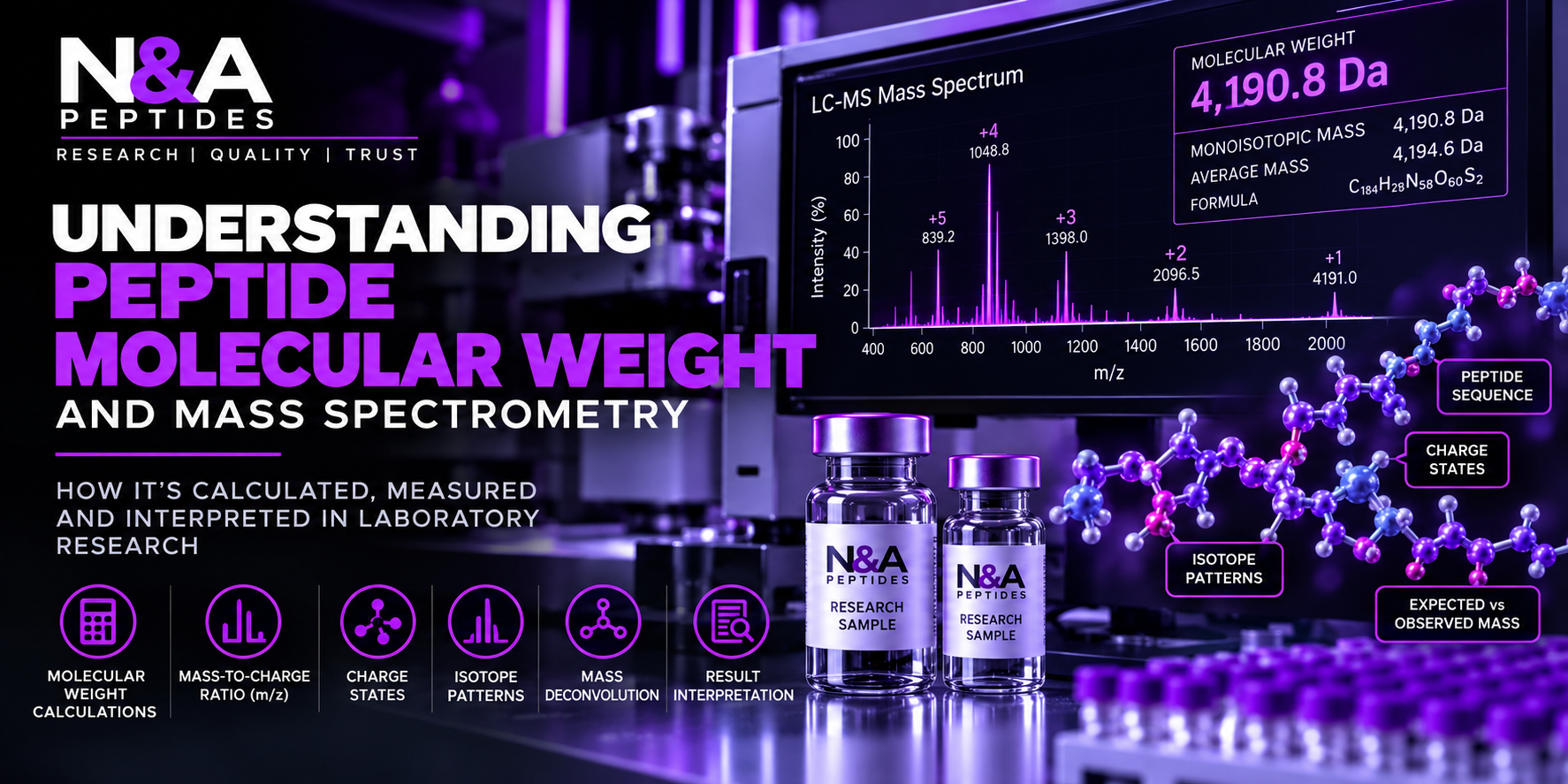
Peptide molecular weight is a fundamental measurement in analytical chemistry. Understanding how molecular mass is calculated, measured and interpreted helps researchers evaluate peptide identity and investigate laboratory results.
Mass spectrometry is widely used to analyse peptides because it can provide precise information about ions derived from molecular samples. Techniques such as liquid chromatography–mass spectrometry (LC-MS) combine chemical separation with mass analysis.
However, understanding peptide molecular weight requires more than simply comparing two numbers. Charge states, isotopic composition, molecular modifications and instrument performance can all influence how analytical results should be interpreted.
This guide explains seven essential concepts in peptide molecular weight and mass spectrometry, including practical examples and common analytical limitations.
1. What Is Peptide Molecular Weight?
Peptide molecular weight is commonly used to describe the mass associated with a peptide molecule, although technically molecular mass and relative molecular mass are distinct quantities.
A peptide consists of amino acid residues connected by peptide bonds. Its molecular mass depends on the elements present in its chemical structure, including any intended terminal modifications or other chemical groups.
Peptide masses are commonly expressed numerically in daltons (Da), while larger molecules may be described using kilodaltons (kDa).
For example, a molecular mass of 2,500 Da is equivalent to 2.5 kDa.
The theoretical mass is calculated from the proposed molecular composition. The experimentally observed mass is obtained through analytical measurement.
Agreement between these values can provide evidence supporting molecular identity, but it does not independently confirm every structural feature.
2. How Is Peptide Molecular Weight Calculated?
Theoretical peptide molecular weight can be calculated from an amino acid sequence and its known chemical modifications.
During peptide bond formation, the chemical composition changes because a water molecule is eliminated for each peptide bond.
For an unmodified linear peptide containing N amino acids, there are normally N minus 1 peptide bonds.
When calculating mass from the masses of free amino acids, the mass of water lost during bond formation must be accounted for.
Alternatively, peptide mass calculations often use amino acid residue masses and add the appropriate terminal groups.
Example: Calculating a Simple Peptide
Consider a hypothetical unmodified peptide consisting of glycine, alanine and serine.
The calculation uses the elemental composition of the three residues, together with the appropriate terminal hydrogen and hydroxyl groups.
Using standard monoisotopic residue masses, the approximate calculation is:
- Glycine residue: 57.02146 Da
- Alanine residue: 71.03711 Da
- Serine residue: 87.03203 Da
- Terminal water contribution: 18.01056 Da
Calculated monoisotopic neutral mass: approximately 233.10116 Da.
This example assumes a conventional, unmodified linear peptide. Chemical modifications, cyclic structures and isotope labelling can alter the calculation.
3. Monoisotopic Mass vs Average Molecular Mass
One important distinction in peptide mass spectrometry is the difference between monoisotopic mass and average molecular mass.
Monoisotopic Mass
Monoisotopic mass is calculated using the exact masses of specified isotopes, generally the most abundant stable isotope of each constituent element.
For common peptide elements, this typically includes carbon-12, hydrogen-1, nitrogen-14, oxygen-16 and sulfur-32.
Monoisotopic mass is particularly useful when interpreting high-resolution mass spectra and assigning molecular compositions.
Average Molecular Mass
Average molecular mass takes account of the natural relative abundances of the isotopes of the elements in a chemical compound.
Because the different isotopes have different masses, average molecular mass and monoisotopic mass do not generally have identical numerical values.
This distinction becomes increasingly important as molecular size increases and isotopic patterns become more complex.
Comparison
| Property | Monoisotopic mass | Average molecular mass |
|---|---|---|
| Calculation basis | Specified isotopes | Natural isotopic abundances |
| Typical application | High-resolution mass assignment | Average molecular composition calculations |
| Numerical result | One defined isotope composition | Abundance-weighted average |
| Important consideration | Monoisotopic signal may be weak in larger molecules | Not necessarily a directly observed individual ion peak |
Laboratory reports should make clear which mass convention is used when theoretical and experimental results are compared.
4. Understanding Mass-to-Charge Ratio (m/z)
Mass spectrometers separate or detect ions according to their mass-to-charge ratio, abbreviated as m/z.
This is not necessarily the same number as the neutral molecular mass of a peptide.
The International Union of Pure and Applied Chemistry (IUPAC) defines m/z in relation to an ion’s mass and charge numbers.
In positive-mode electrospray mass spectrometry, a peptide can acquire multiple protons, producing ions with different positive charge states.
For a protonated ion, the approximate relationship is:
m/z = (M + z × H) / z
Where:
- M is the neutral molecular mass.
- z is the positive charge number.
- H is the mass contribution of a proton, approximately 1.007276 Da.
Example: A Hypothetical 1,000 Da Peptide
A peptide with a neutral mass of 1,000 Da may produce different observed m/z values depending on its charge state.
| Charge state | Approximate m/z |
|---|---|
| +1 | 1001.0073 |
| +2 | 501.0073 |
| +3 | 334.3406 |
| +4 | 251.0073 |
These values represent hypothetical protonated ions, not experimental data from an actual peptide sample.
A single molecular species can therefore produce several peaks at different m/z values.
For the official terminology, see the IUPAC Gold Book definition of mass-to-charge ratio.
5. What Are Charge States and Mass Deconvolution?
Electrospray ionisation (ESI) is frequently used in peptide mass spectrometry because it can generate ions carrying multiple electrical charges.
A peptide molecule may produce a series of peaks corresponding to different charge states.
These peaks can be mathematically analysed to estimate the mass of the original neutral molecule.
This processing step is called mass spectral deconvolution.
How Does Deconvolution Work?
Deconvolution algorithms identify relationships between measured peaks, estimate their charge assignments and calculate a molecular mass consistent with the observed signals.
The process may also account for isotope distributions and overlapping spectral features.
Researchers should recognise that deconvolution is a data-processing operation rather than an independent experimental measurement.
Its reliability depends on signal quality, instrument resolution, suitable algorithms and the complexity of the sample.
For further technical background, see the published research article Automated Deconvolution and Deisotoping of Electrospray Mass Spectra.
6. Why Do Peptides Produce Isotope Patterns?
Chemical elements can exist as different isotopes, which contain different numbers of neutrons.
Because peptide molecules contain elements with naturally occurring isotopes, mass spectra may display clusters of closely spaced peaks rather than one isolated signal.
For example, carbon-13 contributes to isotope distributions in compounds containing carbon atoms.
High-resolution instruments may resolve individual isotope peaks, allowing more detailed examination of the isotopic envelope.
What Can an Isotope Pattern Tell Researchers?
Under suitable analytical conditions, isotope information can help support:
- Charge-state determination.
- Molecular composition assessment.
- Distinguishing overlapping ion signals.
- Monoisotopic peak assignment.
- Evaluation of spectral data quality.
The interpretation becomes more challenging for larger molecules because isotope distributions may become increasingly complex.
Additional evidence may be required to distinguish competing molecular assignments.
7. Expected Mass vs Observed Mass: What Does the Difference Mean?
Analytical reports sometimes provide both an expected theoretical molecular mass and an experimentally observed molecular mass.
Comparing these values can help researchers investigate whether the measured data are consistent with a proposed molecular structure.
However, a small difference between the two values is not automatically evidence of an impurity or incorrect product identity.
Potential explanations include:
- Measurement uncertainty.
- Instrument calibration differences.
- Incorrect charge-state assignment.
- Differences between average and monoisotopic mass.
- Adduct formation.
- Isotope-peak assignment.
- Chemical modifications or degradation products.
What Is Mass Accuracy in Parts Per Million (ppm)?
Mass accuracy is frequently expressed in parts per million, abbreviated as ppm.
The signed mass error is commonly calculated as:
Mass error (ppm) = [(observed mass − theoretical mass) / theoretical mass] × 1,000,000
For example, if a theoretical mass is 1,000.000 Da and a measured mass is 1,000.005 Da, the calculated mass error is +5 ppm.
The acceptable mass error depends on the instrument, method, analytical objective and established performance criteria.
Mass accuracy alone does not determine peptide identity or purity.
How Is Peptide Molecular Weight Verified Using LC-MS?
Liquid chromatography–mass spectrometry combines a separation process with mass spectrometric detection.
The chromatography stage can separate sample components before they enter the mass spectrometer.
The mass spectrometer then measures ion signals at different mass-to-charge ratios.
This combination can help laboratories investigate the molecular masses of different chromatographic components.
Read our HPLC vs LC-MS Peptide Testing guide for a detailed explanation of these analytical methods.
Can Mass Spectrometry Detect Peptide Impurities?
Mass spectrometry can help investigate peptide-related impurities when they produce detectable ion signals and can be distinguished under the selected analytical conditions.
For example, some deletion sequences, oxidation products and other chemical modifications may produce measurable mass differences.
However, certain structural isomers have identical molecular masses, making them difficult to distinguish using mass measurements alone.
Analytical detection also depends on factors such as ionisation efficiency, sample preparation and instrument performance.
For more information, explore our guide to peptide impurities and laboratory testing.
What Does Molecular Weight Tell Us on a Certificate of Analysis?
A Certificate of Analysis may include information about expected mass, observed mass and the analytical method used.
These results can provide supporting evidence concerning the molecular composition of a sample.
When reviewing mass spectrometry results, researchers should check whether the report identifies:
- The sample name and batch identifier.
- The analytical technique.
- The expected molecular mass.
- The observed molecular mass.
- The mass convention used.
- Charge-state assignments where applicable.
- Any reported mass error or uncertainty.
- The date and laboratory responsible for testing.
For more guidance, see How to Read a Peptide Certificate of Analysis.
A matching molecular mass does not independently establish purity, sterility, biological activity or suitability for any particular use.
Frequently Asked Questions
Is Peptide Molecular Weight the Same as Molecular Mass?
The expressions are often used interchangeably in laboratory communication. Strictly speaking, molecular mass is an absolute mass, whereas relative molecular mass is dimensionless.
Does a Higher Molecular Weight Mean a Peptide Is More Complex?
Not necessarily. Molecular mass reflects elemental composition and does not independently describe structural complexity or biological behaviour.
Can Two Different Peptides Have the Same Molecular Mass?
Yes. Different sequences or structural isomers can share the same molecular mass. Additional analytical evidence may be necessary to distinguish them.
Why Are There Multiple Peaks in a Peptide Mass Spectrum?
Multiple signals can arise from different charge states, isotopes, adducts, impurities or other detectable molecular species.
Is a Mass Spectrum the Same as an HPLC Chromatogram?
No. A mass spectrum presents ion intensity against m/z, while a conventional chromatogram presents detector response against a separation coordinate, commonly retention time.
Can Molecular Weight Confirm Peptide Purity?
No. Molecular mass analysis supports identification, but a complete purity assessment requires an appropriate analytical method and consideration of other potential components.
Scientific References
- IUPAC Gold Book — Mass-to-Charge Ratio.
- Wehofsky and Hoffmann — Automated Deconvolution and Deisotoping of Electrospray Mass Spectra. Journal of Mass Spectrometry, 2002.
- Charge Ratio Analysis Method for the Deconvolution of Electrospray Mass Spectra.
- A Universal Score for Deconvolution of Intact Protein and Native Electrospray Mass Spectra. Analytical Chemistry, 2020.
Conclusion: Understanding Peptide Molecular Weight
Peptide molecular weight and mass spectrometry are closely connected aspects of modern analytical chemistry.
Theoretical mass calculations, observed m/z values, charge-state analysis and isotope patterns can provide complementary information about molecular composition.
Understanding the differences between these measurements is essential when interpreting peptide laboratory results.
Mass spectrometry offers powerful evidence, but conclusions about identity, purity and sample composition must remain consistent with the analytical methods and supporting data.
Explore more educational articles in the N&A Peptides Research Guides.
Research information only: This article is intended for educational discussion of analytical laboratory science. It does not establish the safety, efficacy, sterility or suitability of any peptide for human or veterinary use.