
Blog
Endotoxin Testing in Peptide Research: Methods and Quality Control

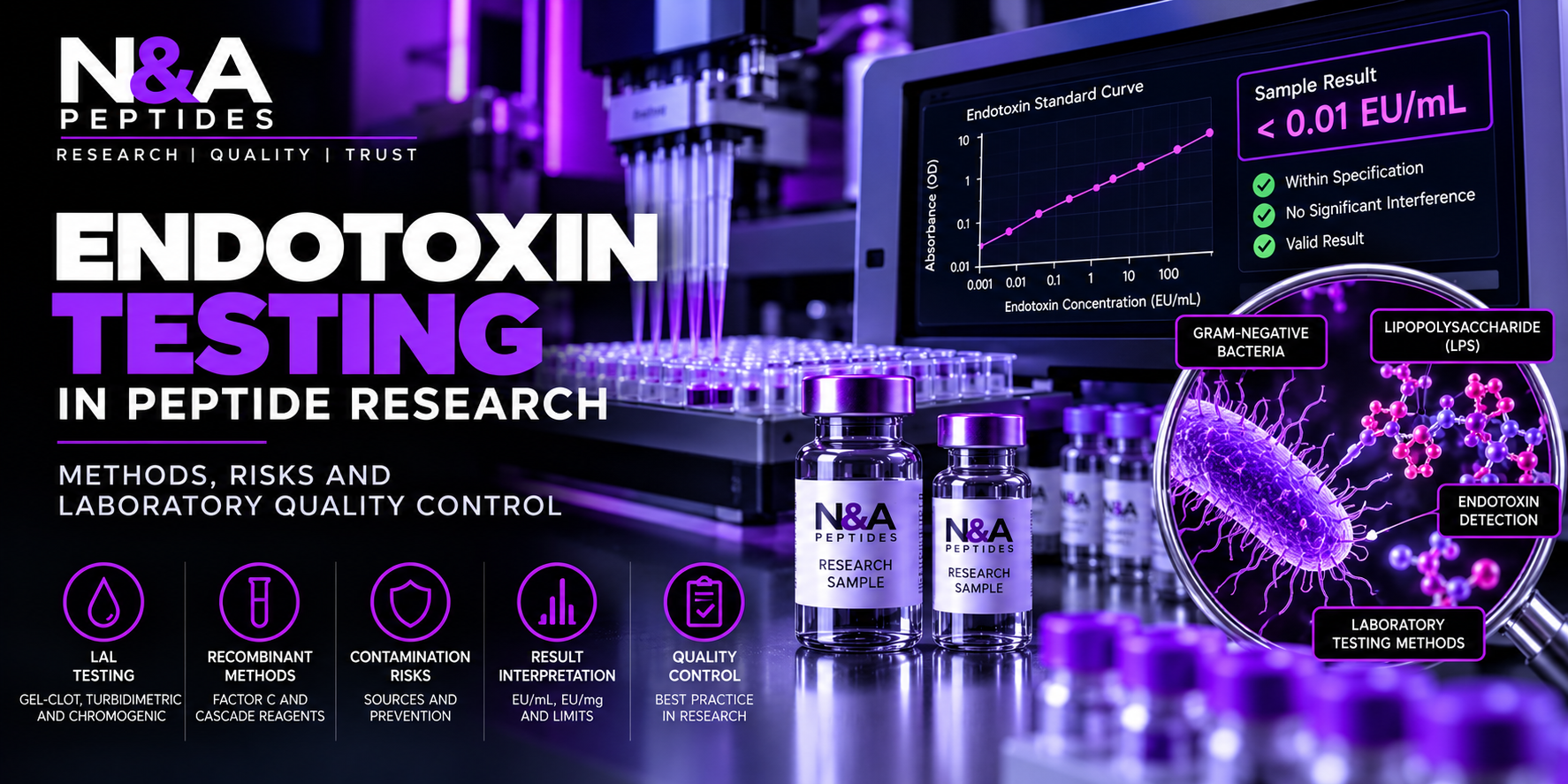
Endotoxin testing is an important area of laboratory quality control, particularly when evaluating materials that may have been exposed to bacterial contamination. In peptide research, understanding bacterial endotoxins helps researchers distinguish chemical purity from microbiological quality.
A peptide sample can demonstrate a high chromatographic purity percentage and still contain endotoxins. This is because analytical techniques designed to measure peptide composition do not necessarily detect bacterial endotoxin contamination.
This guide explains what bacterial endotoxins are, why they matter, how laboratories investigate them, and the differences between established and newer analytical methods.
What Is Endotoxin Testing?
Endotoxin testing is the laboratory detection or measurement of bacterial endotoxins in a sample.
Bacterial endotoxins are associated with lipopolysaccharides (LPS), major components of the outer membrane of Gram-negative bacteria.
LPS molecules contain a lipid A region, which is primarily responsible for their characteristic biological activity.
These substances can remain present after bacteria are no longer viable. Therefore, testing for living microorganisms and testing for bacterial endotoxins are different analytical objectives.
Endotoxin testing is particularly important in pharmaceutical manufacturing, medical devices and other applications where specific microbiological quality requirements apply.
For laboratory research peptides, its relevance depends on the intended research application and the testing requirements established for the material.
Why Can Endotoxins Be Important in Peptide Research?
Endotoxins can influence biological systems, including inflammatory signalling and innate immune responses.
This can create complications when researchers are investigating biological activity, inflammatory pathways or other cellular responses.
For example, a researcher examining the effects of a particular peptide on cultured cells may need to consider whether an observed inflammatory response could be affected by bacterial endotoxin contamination rather than the peptide itself.
This is one reason why sample characterisation and appropriate experimental controls are important.
However, not every peptide research experiment requires the same endotoxin specification or testing programme.
How Can Bacterial Endotoxin Contamination Occur?
Potential sources include contaminated water, laboratory materials, certain raw ingredients, processing equipment and environmental exposure.
Possible contributing factors include:
- Water or aqueous materials that contain bacterial endotoxins.
- Contaminated laboratory vessels or processing equipment.
- Raw materials introducing unwanted microbial components.
- Insufficient control of relevant manufacturing environments.
- Handling or processing conditions that introduce contamination.
The presence of endotoxins cannot be reliably determined by the appearance, colour or clarity of a sample.
Appropriate analytical methods are required when endotoxin content needs to be established.
5 Important Endotoxin Testing Methods and Approaches
1. LAL Gel-Clot Testing
The Limulus Amebocyte Lysate (LAL) test uses reagents originally derived from horseshoe crab blood cells.
The gel-clot method detects endotoxin activity through a reaction that can form a gel under defined analytical conditions.
Results are generally interpreted against the method’s specified sensitivity and acceptance criteria.
The gel-clot method has an established history in pharmaceutical endotoxin testing, but test suitability must be demonstrated for the material under investigation.
2. Kinetic Turbidimetric Testing
Kinetic turbidimetric methods monitor changes in optical properties as an endotoxin-dependent reaction progresses.
The reaction rate can be related to endotoxin activity using suitable calibration.
These methods can support quantitative analysis when appropriate validation, controls and sample suitability have been established.
3. Chromogenic Endotoxin Testing
Chromogenic methods use a reaction that generates a measurable colour signal.
The resulting optical response can be evaluated against appropriate standards to estimate bacterial endotoxin activity.
Method performance may be influenced by sample characteristics, including substances that interfere with the reaction or its detection.
4. Recombinant Factor C Testing
Recombinant Factor C (rFC) methods use a laboratory-produced version of a protein involved in the endotoxin-sensitive reaction pathway.
These methods offer an alternative to approaches dependent on animal-derived lysate reagents.
USP Chapter 86 describes bacterial endotoxin testing techniques using recombinant reagents, including rFC.
The applicability of a recombinant method depends on regulatory context, method suitability and relevant verification or validation requirements.
5. Recombinant Cascade Reagent Testing
Recombinant cascade reagent (rCR) methods use multiple recombinant proteins representing components of the endotoxin-responsive cascade.
Like rFC methods, these techniques avoid the need for conventional horseshoe crab-derived lysate.
USP Chapter 86 includes both recombinant Factor C and recombinant cascade reagent approaches.
Neither approach should be assumed suitable for every sample without appropriate laboratory verification.
Comparison of Endotoxin Testing Methods
| Method | General principle | Important consideration |
|---|---|---|
| Gel-clot LAL | Gel formation reaction | Endpoint interpretation and assay interference |
| Kinetic turbidimetric | Optical reaction monitoring | Calibration and sample effects |
| Chromogenic | Colour-producing reaction | Optical interference and assay suitability |
| Recombinant Factor C | Recombinant endotoxin-responsive protein | Method suitability and applicable standards |
| Recombinant cascade | Multiple recombinant cascade proteins | Verification and sample compatibility |
The most appropriate method depends on the sample, intended purpose, applicable quality standards and demonstrated analytical performance.
What Are Endotoxin Units (EU)?
Endotoxin activity is frequently reported in endotoxin units, abbreviated as EU.
An endotoxin unit represents biological activity relative to an established reference standard rather than a universal mass of endotoxin.
Depending on the application, laboratory results may be reported in units such as EU/mL or EU/mg.
For example, EU/mL describes measured endotoxin activity relative to the volume of the tested preparation.
EU/mg relates the measured activity to a stated mass basis.
Different reporting units should not be compared directly without understanding the sample concentration, calculation method and units involved.
Does 99% Peptide Purity Mean a Sample Is Endotoxin-Free?
No. This is one of the most important distinctions in analytical peptide testing.
A high-performance liquid chromatography (HPLC) purity result measures specific chromatographic characteristics under defined analytical conditions.
It does not automatically establish:
- The absence of bacterial endotoxins.
- Sterility.
- The absence of all microorganisms.
- The absence of every chemical impurity.
- Biological safety or suitability for administration.
A sample may therefore have high chromatographic purity while still requiring separate microbiological or chemical assessments for a particular application.
Read our guide to understanding 99% peptide purity for a more detailed explanation.
Can HPLC or LC-MS Detect Endotoxins?
Conventional peptide purity testing by HPLC or LC-MS is not equivalent to a bacterial endotoxins test.
Although specialised analytical techniques can investigate components of lipopolysaccharides, ordinary peptide HPLC and LC-MS reports should not be interpreted as evidence that endotoxin testing has been completed.
The analytical method must be designed and demonstrated to detect the substance or characteristic of interest.
For a comparison of peptide analytical methods, explore our HPLC vs LC-MS Peptide Testing guide.
What Can Interfere With Endotoxin Testing?
Sample-related interference is an important consideration in endotoxin analysis.
Some sample components may inhibit or enhance an analytical reaction, affecting the reliability of the resulting measurement.
Potential interference depends on the method and may involve sample pH, chemical composition, optical characteristics or other reactive substances.
Beta-Glucan Interference
Certain traditional LAL reagent systems can respond to beta-glucans through a pathway distinct from the endotoxin-responsive Factor C pathway.
This can complicate interpretation when a sample contains substances that produce a non-endotoxin-related response.
Recombinant Factor C assays avoid the traditional Factor G activation pathway, although other forms of sample interference must still be considered.
The National Cancer Institute discusses the role of beta-glucan interference in LAL-based laboratory testing.
Read the NCI explanation of LAL reaction pathways and beta-glucan interference.
How Do Laboratories Verify Endotoxin Test Suitability?
Before relying on results, laboratories need to establish that the chosen analytical procedure is appropriate for the sample and intended testing purpose.
Depending on the method and application, this can include appropriate calibration, blanks, controls and an evaluation of sample interference.
A commonly used principle is to demonstrate that the sample matrix does not prevent meaningful detection of a known endotoxin response.
Relevant regulatory or compendial requirements must be considered where testing is conducted for regulated pharmaceutical products.
The FDA’s March 2026 guidance provides recommendations relating to endotoxin test methodologies and acceptance criteria in relevant regulated contexts.
See the FDA Pyrogen and Endotoxins Testing Guidance.
Endotoxin Testing vs Sterility Testing
Endotoxin testing and sterility testing answer different questions.
| Feature | Endotoxin testing | Sterility testing |
|---|---|---|
| Primary objective | Detection of bacterial endotoxin activity | Assessment for viable microorganisms under specified test conditions |
| Can detect non-viable bacterial endotoxin? | Yes, where the assay detects the endotoxin present | Not its primary purpose |
| Can establish sterility? | No | Supports assessment against applicable sterility requirements |
| Can detect all pyrogens? | No | No |
A sample passing one test does not automatically establish that it would pass the other.
Endotoxin Testing and the Certificate of Analysis
A Certificate of Analysis (COA) documents the results of particular tests performed on a sample or batch.
Not every COA includes endotoxin testing, and a report should never be assumed to cover tests that are not explicitly identified.
When an endotoxin result is provided, useful information may include:
- Sample and batch identification.
- Name of the testing laboratory.
- Test method and applicable standard.
- Units used to report endotoxin activity.
- Reported results and relevant detection or quantitation limits.
- Applicable acceptance criteria, where established.
- Testing date and report identification.
- Information about sample suitability where relevant.
A result that falls below a particular analytical limit does not necessarily establish that the sample contains absolutely no endotoxin.
Our guide to reading a Peptide Certificate of Analysis explains how to interpret laboratory reports and their limitations.
Endotoxins vs Other Peptide Impurities
Peptide-related impurities and bacterial endotoxins are different categories of potential sample contaminants.
Peptide-related impurities may include deletion sequences, oxidation products, truncated peptides and other chemically modified species.
Bacterial endotoxins originate from Gram-negative bacterial structures and generally require different analytical approaches.
A thorough investigation therefore depends on identifying which quality attributes are relevant to the research application.
For further reading, see our Peptide Impurities and Laboratory Testing guide.
New Developments in Endotoxin Testing
Analytical methods for endotoxin testing have continued to evolve, including the development and regulatory consideration of recombinant reagent systems.
USP Chapter 86 became official in May 2025, providing additional bacterial endotoxin test techniques using recombinant reagents.
In March 2026, the FDA updated its guidance to better accommodate the use of recombinant reagents and emphasised that method suitability must be established for the intended purpose.
These developments are relevant to laboratories evaluating alternative analytical methods, although the applicable requirements depend on the product and regulatory context.
See the FDA explanation of its updated endotoxin testing position.
Frequently Asked Questions About Endotoxin Testing
What Is the Purpose of Endotoxin Testing?
The purpose is to detect or quantify bacterial endotoxin activity in a sample using a suitable analytical procedure.
Can Endotoxins Be Present in a High-Purity Peptide?
Yes. Chromatographic peptide purity and endotoxin content are different analytical measurements.
Does Endotoxin Testing Confirm Sterility?
No. Endotoxin testing does not establish the absence of viable microorganisms.
What Is the Difference Between LAL and Recombinant Factor C?
Traditional LAL systems use reagents derived from horseshoe crab amebocytes. Recombinant Factor C systems use a laboratory-produced protein to detect endotoxin-associated activity.
Are Endotoxins the Same as All Pyrogens?
No. Bacterial endotoxins are an important class of pyrogenic substances, but other substances can also produce pyrogenic responses.
Does a COA Automatically Include Endotoxin Testing?
No. A COA normally reports specific tests. Endotoxin testing should only be considered completed when appropriate evidence is explicitly provided.
Scientific References
- US Food and Drug Administration — Pyrogen and Endotoxins Testing: Questions and Answers, March 2026.
- United States Pharmacopeia — General Chapter 86, Bacterial Endotoxins Test Using Recombinant Reagents.
- FDA — Current Thinking on Pyrogen and Endotoxins Testing.
- National Cancer Institute — LAL Reaction Pathways and Beta-Glucan Interference.
- Roslansky and Novitsky — Sensitivity of Limulus Amebocyte Lysate to LAL-Reactive Glucans.
Conclusion: Understanding Endotoxin Testing in Peptide Research
Endotoxin testing provides information about an important category of bacterial contamination that cannot be assessed simply by examining chromatographic peptide purity.
Different analytical methods, including LAL and recombinant reagent systems, offer approaches to detecting endotoxin activity.
Reliable interpretation depends on suitable methods, appropriate controls, clear reporting and an understanding of the limitations of each test.
Researchers should distinguish endotoxin analysis from sterility testing, chemical purity measurement and other sample quality assessments.
Explore more scientific explanations in the N&A Peptides Research Guides.
Research information only: This article is intended for educational discussion of laboratory analytical science. It does not establish the safety, efficacy, sterility or suitability of any research peptide for human or veterinary use.