Blog
TB-500 Peptide Research: What Does the Scientific Evidence Show?

TB-500 Peptide Research: What Does the Scientific Evidence Show?
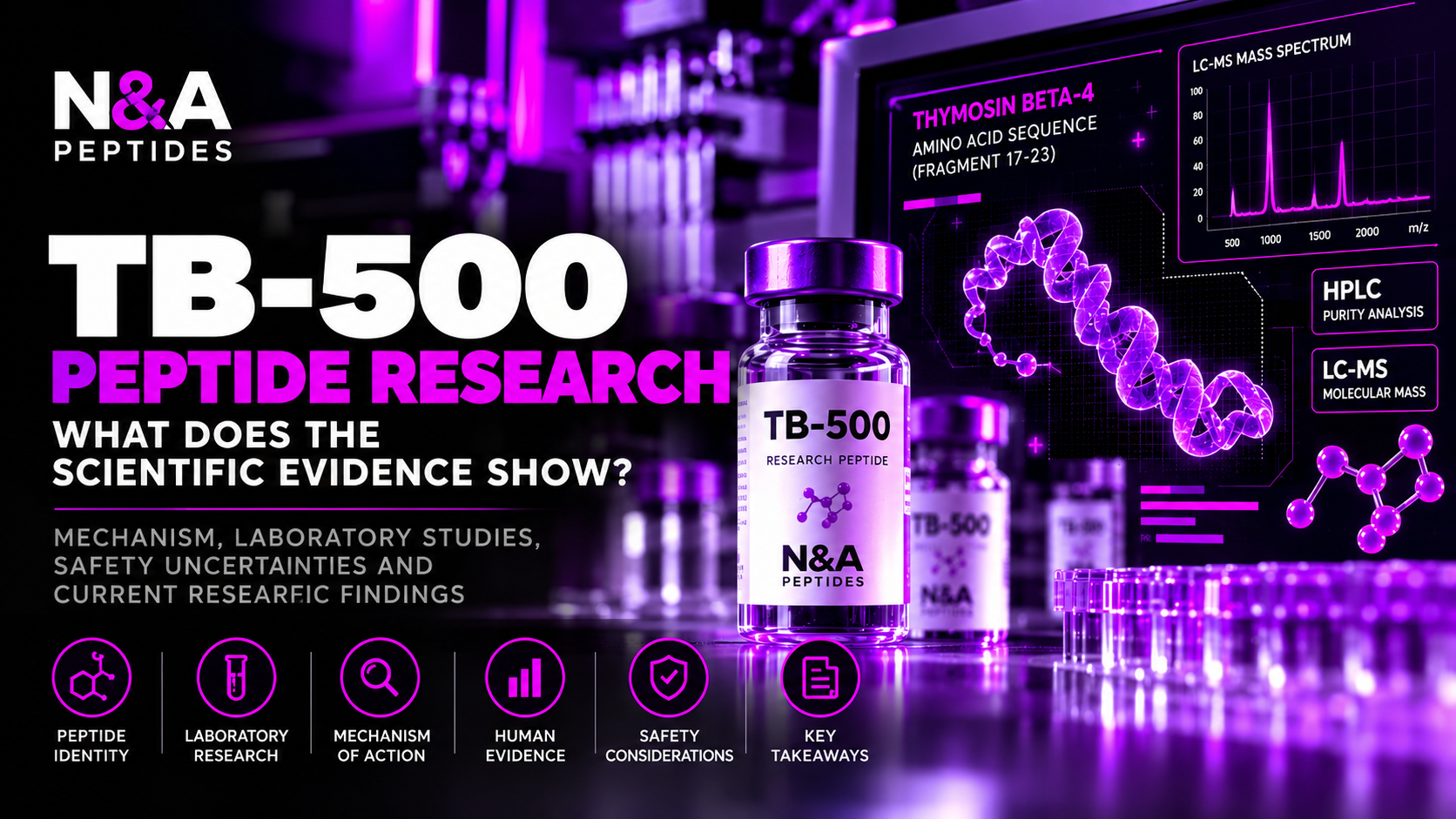
TB-500 peptide research has attracted increasing attention in the fields of cellular biology, tissue repair and regenerative science. Much of this interest originates from studies investigating thymosin beta-4, a naturally occurring protein involved in important cellular processes.
However, understanding the difference between TB-500 and thymosin beta-4 is essential when interpreting scientific findings. Although these names are sometimes used interchangeably, they do not always describe the same molecular structure.
This N&A Peptides research guide examines TB-500, its molecular background, proposed biological mechanisms, published laboratory findings, analytical testing methods and the limitations of current evidence.
What Is TB-500 Peptide?
TB-500 is commonly described in scientific and anti-doping literature as a synthetic peptide derived from thymosin beta-4 (Tβ4). The designation is frequently associated with a short peptide fragment corresponding to amino acids 17–23 of the parent protein.
Thymosin beta-4 itself is a naturally occurring protein consisting of 43 amino acids. It is present in numerous tissues and participates in processes connected with cellular organisation and movement.
One important consideration is that TB-500 naming conventions vary across different sources. Some publications discuss the shorter synthetic fragment, while others investigate the full-length thymosin beta-4 protein.
These differences matter because molecular structure influences biological activity. Research findings involving full-length thymosin beta-4 cannot automatically be assumed to apply to every synthetic fragment.
For additional background on laboratory peptides, read our Research Peptides UK Guide.
TB-500 vs Thymosin Beta-4: Understanding the Difference
One of the most common sources of confusion in peptide research concerns the relationship between TB-500 and thymosin beta-4.
Full-Length Thymosin Beta-4
Thymosin beta-4 is a 43-amino-acid protein that has been investigated extensively for its interaction with actin, a fundamental component of the cellular cytoskeleton.
Actin participates in cellular movement, structural organisation and numerous other biological activities.
Researchers have investigated whether thymosin beta-4 influences cellular migration, inflammatory signalling, angiogenesis and tissue-related biological processes.
The TB-500 Fragment
TB-500 is commonly associated with a shorter synthetic sequence derived from the actin-binding region of thymosin beta-4.
Because the fragment contains fewer amino acids, its molecular properties may differ from those of the full-length protein.
Scientific interpretation therefore requires accurate identification of the molecule under investigation rather than relying solely on the name used in a publication or product description.
How Does Thymosin Beta-4 Work?
Much of the scientific interest surrounding thymosin beta-4 involves its relationship with actin regulation.
Actin exists in different forms inside cells, including monomeric G-actin and filamentous F-actin. The balance between these forms contributes to cellular structure, movement and organisation.
Thymosin beta-4 can bind to actin monomers and influence the availability of actin for filament formation.
This relationship is relevant to several important cellular processes:
- Cell migration: Movement of cells during normal biological activity.
- Cytoskeletal organisation: Maintenance and reorganisation of cellular structures.
- Cell differentiation: Processes through which cells develop specialised functions.
- Tissue organisation: Interactions involved in maintaining biological tissues.
- Cellular signalling: Communication pathways influencing biological responses.
A scientific review titled Thymosin β4 and Actin: Binding Modes, Biological Functions and Clinical Applications examines these molecular interactions in detail.
Importantly, identifying a biological mechanism does not establish that administering TB-500 produces a clinically beneficial effect in humans.
TB-500 and Tissue Repair Research
One reason TB-500 is frequently discussed is the broader research surrounding thymosin beta-4 and tissue biology.
Scientists have investigated the parent protein in experimental models involving wound repair and cellular regeneration.
Some laboratory and animal studies have reported effects on cellular migration and biological processes associated with tissue repair.
For example, research published in Wound Repair and Regeneration investigated full-length thymosin beta-4 and a synthetic peptide containing its actin-binding domain in mouse models.
The researchers reported findings related to dermal wound repair under their experimental conditions.
The original publication can be accessed through PubMed: Thymosin Beta-4 and Synthetic Peptide Research in Mice.
However, animal findings have important limitations. They cannot establish that TB-500 injections safely or effectively repair human tendons, ligaments, muscles or other injured tissues.
What Does Research Say About Cell Migration?
Cell migration is a fundamental biological process involved in development, tissue maintenance and experimental models of wound repair.
Because thymosin beta-4 interacts with the cellular actin system, researchers have studied its potential influence on how cells move.
One investigation examined the actin-binding region of thymosin beta-4 and its relationship with angiogenesis, which is the formation of new blood vessels.
Experimental findings suggested that certain sequences within the protein could influence endothelial cell behaviour in laboratory models.
Read the original scientific publication: The Actin Binding Site on Thymosin Beta-4 Promotes Angiogenesis.
These findings contribute to understanding the biological properties of thymosin beta-4, but they do not demonstrate clinical effectiveness or safety for TB-500.
TB-500, Inflammation and Cellular Signalling
Another area of scientific investigation concerns the relationship between thymosin beta-4 and inflammatory responses.
Inflammation involves complex interactions between immune cells, signalling molecules and surrounding tissues.
Researchers have examined whether different regions of thymosin beta-4 influence aspects of inflammatory signalling in experimental systems.
Some biological activities are associated with specific peptide sequences rather than the complete protein acting as a single uniform structure.
A paper titled Biological Activities of Thymosin Beta-4 Defined by Active Sites in Short Peptide Sequences explores these structure-function relationships.
This distinction is particularly relevant when comparing the evidence for full-length thymosin beta-4 with findings involving shorter fragments.
What Does Human Clinical Evidence Show?
Although thymosin beta-4 has been studied in preclinical research and certain human clinical investigations, direct clinical evidence concerning the TB-500 fragment remains limited.
Some studies have examined pharmaceutical formulations of full-length thymosin beta-4 for specific conditions, including ocular surface disorders.
These studies should not be treated as evidence that TB-500 itself is effective for injury recovery.
There is insufficient direct, high-quality human clinical evidence to establish that TB-500 safely and effectively treats muscle injuries, tendon problems or ligament damage.
Important unanswered questions include long-term safety, the biological activity of specific fragments, adverse effects and whether findings from preclinical experiments can be reproduced in controlled human studies.
For these reasons, claims that TB-500 has been proven to heal injuries go beyond the available scientific evidence.
Why Peptide Purity Testing Matters
Reliable scientific research depends on accurate identification and characterisation of the substances used in experiments.
For synthetic peptides, analytical testing can help researchers investigate molecular identity, sample composition and potential impurities.
Laboratories commonly use several complementary analytical methods.
High-Performance Liquid Chromatography (HPLC)
HPLC separates chemical components within a sample. Under a validated analytical method, the resulting chromatogram can help laboratories assess composition and chromatographic purity.
However, a purity percentage does not independently establish peptide identity, sterility or suitability for human administration.
Read more in our Peptide Purity Testing Guide.
Liquid Chromatography–Mass Spectrometry (LC-MS)
LC-MS combines chromatographic separation with mass spectrometric analysis.
This allows researchers to gather additional information about molecular mass and sample components.
Because different techniques provide different information, laboratories may use more than one analytical method to characterise a research peptide.
For a comparison of these techniques, visit our HPLC vs LC-MS Peptide Testing Guide.
Molecular Weight and Identity
Determining the expected molecular mass is another important step in peptide characterisation.
For TB-500 research, molecular identity is particularly important because the fragment and full-length thymosin beta-4 represent different molecular structures.
Our article on Peptide Molecular Weight and Mass Spectrometry explains how these measurements are used in analytical research.
Understanding Certificates of Analysis
A Certificate of Analysis, commonly called a COA, is a document presenting analytical information associated with a particular material or batch.
Depending on the testing performed, a COA may contain details such as the sample identifier, batch reference, analytical methodology, reported purity and test results.
Researchers should consider whether the analytical results correspond to the correct molecular structure and whether the documentation provides appropriate traceability.
Independent testing can provide useful analytical evidence, but even a high reported purity does not demonstrate that a material is clinically safe or approved.
For further information, see our Understanding Peptide Certificates of Analysis guide.
Peptide Impurities and Research Quality
Synthetic peptide manufacturing may produce impurities associated with incomplete reactions, unwanted chemical modifications or degradation.
The presence and nature of these impurities can affect the interpretation of experimental observations.
Scientific research therefore benefits from appropriate analytical controls and transparent documentation.
Potential issues include unidentified sample components, incorrect molecular identity, degradation products and differences between manufacturing batches.
Learn more in our Peptide Impurities and Laboratory Testing article.
Storage and Stability Considerations
Peptides may be sensitive to environmental conditions, depending on their molecular structure, formulation and physical state.
Variables such as temperature, moisture, light and handling conditions can influence the stability of certain research materials.
Because stability is compound-specific, researchers should consult validated stability data rather than assume that every peptide behaves identically.
Our Lyophilised Peptides: Storage and Handling guide explains the scientific principles behind peptide stability and documentation.
TB-500 Safety and Regulatory Considerations
TB-500 is not an approved UK medicine for treating injuries or accelerating recovery.
The lack of sufficient direct human evidence means that its safety profile, clinical effectiveness and longer-term risks have not been adequately established.
It is also important to distinguish laboratory research materials from medicines that have undergone appropriate clinical and regulatory assessment.
Furthermore, thymosin beta-4 and its derivatives, including TB-500, are prohibited in competitive sport under World Anti-Doping Agency rules.
For additional information, consult Sport Integrity Australia’s Thymosin Beta-4 Guidance.
Frequently Asked Questions About TB-500
What is TB-500 peptide?
TB-500 commonly refers to a synthetic peptide fragment associated with thymosin beta-4, a naturally occurring protein involved in actin-related cellular processes.
Is TB-500 the same as thymosin beta-4?
Not necessarily. Full-length thymosin beta-4 contains 43 amino acids, whereas TB-500 commonly describes a shorter fragment. Terminology varies between sources.
Has TB-500 been proven to repair injuries?
No. Current direct human clinical evidence is insufficient to establish that TB-500 safely or effectively repairs injuries.
Why is TB-500 discussed in peptide research?
Scientific interest comes largely from experimental work involving thymosin beta-4, actin regulation, cell migration and tissue biology.
Can HPLC confirm TB-500 identity?
HPLC provides information about sample composition. Additional analytical methods, such as mass spectrometry, can be necessary to support molecular identification.
Is TB-500 approved for use in the UK?
No. TB-500 is not an authorised UK medicine for human injury treatment or recovery.
Future Directions in TB-500 Research
Future scientific progress will depend on clearly identifying the compounds being studied and developing reliable evidence about their biological properties.
Important research priorities include comparing different thymosin beta-4 fragments, establishing structure-function relationships and investigating potential safety concerns.
Well-designed studies would also need to distinguish observations in isolated cells or animals from outcomes in humans.
Accurate peptide characterisation, reproducible analytical methods and transparent reporting remain essential foundations for this work.
Conclusion: Understanding the Science Behind TB-500
TB-500 peptide research remains an area of scientific interest because of its relationship with thymosin beta-4 and the biological processes investigated in laboratory studies.
Research involving the parent protein has contributed to understanding actin regulation, cellular migration, angiogenesis and experimental tissue-repair mechanisms.
Nevertheless, promising laboratory observations should not be confused with established clinical treatments.
The available evidence does not currently demonstrate that TB-500 safely and effectively treats injuries in humans.
For researchers, the most important considerations remain accurate molecular identification, reliable analytical testing, careful evaluation of published evidence and appropriate interpretation of experimental findings.
Scientific References and Further Reading
- Thymosin β4 and Actin: Binding Modes, Biological Functions and Clinical Applications — PubMed.
- Biological Activities of Thymosin Beta-4 Defined by Active Sites in Short Peptide Sequences — PubMed.
- Thymosin Beta-4 and a Synthetic Peptide Containing Its Actin-Binding Domain Promote Dermal Wound Repair in Mice — PubMed.
- The Actin Binding Site on Thymosin Beta-4 Promotes Angiogenesis — PubMed.
- Thymosin Beta-4: Regulatory and Anti-Doping Information — Sport Integrity Australia.
Explore More N&A Peptides Research Guides
Continue exploring scientific topics through the N&A Peptides Research Guides library, including analytical testing, laboratory documentation, molecular characterisation and peptide stability.
Disclaimer: This article is provided for scientific education and informational purposes only. It does not provide medical advice, recommend the administration of TB-500 or establish the safety or effectiveness of unapproved substances for human use.